
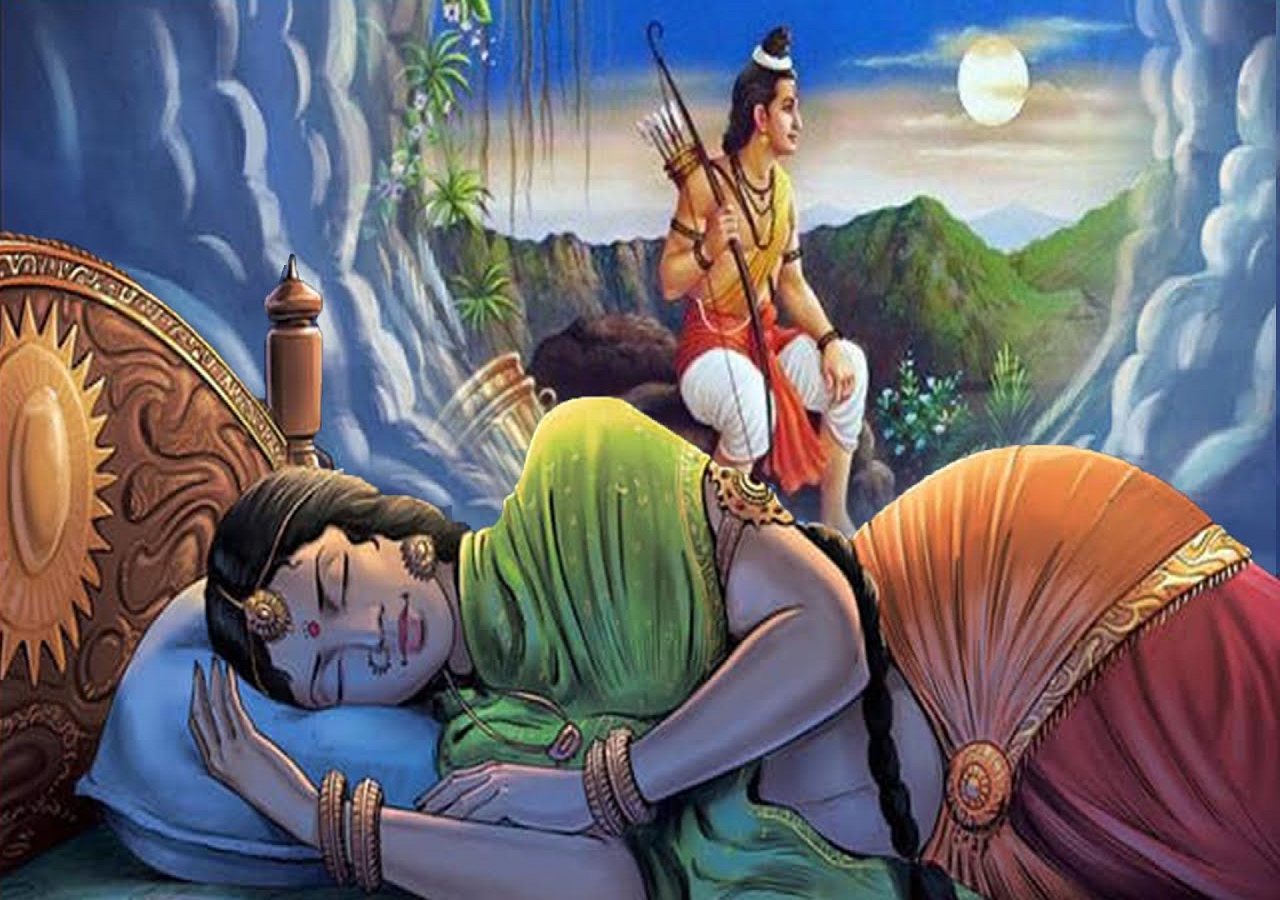
According to Hindu mythology, when Lord Rama went into exile for 14 years, his younger brother Lakshmana accompanied him along with Sita. Legends say that during this entire period, Lakshmana did not sleep even for a single day, remaining alert through the night to protect Rama and Sita from danger.
Because of this extraordinary self-control, Lakshmana earned the name “Gudakesh,” which means one who has conquered sleep.
Lakshmana and the Death of Meghnad (Indrajit)
During the war of Lanka, Lakshmana played a crucial role by killing Meghnad, also known as Indrajit, the eldest son of Ravana and one of the most powerful warriors of his time. Meghnad had received a divine boon that made him nearly invincible.
According to legend, Meghnad once defeated the gods, including Indra, during a battle for control of heaven. As a result of this victory, he was named Indrajit—the conqueror of Indra. After the battle, he took Indra captive to Lanka. To secure Indra’s release, Lord Brahma granted Meghnad a boon.
Although Brahma refused to make him immortal, he granted Meghnad a powerful condition: only a person on Earth who had not slept for 14 years could kill him.
Why Couldn’t Rama Kill Meghnad?
It is said that Sage Agastya once explained that even Lord Rama himself could not defeat Meghnad due to this divine protection. Only Lakshmana, who had remained ever-vigilant throughout the years of exile, fulfilled the condition of the boon.
According to legends, when Sage Agastya visited Ayodhya, Lord Rama mentioned that he had defeated mighty warriors like Ravana and Kumbhakarna, while Lakshmana had slain formidable demons such as Meghnad and Atikaya.
Sage Agastya remarked that although Ravana and Kumbhakarna were immensely powerful, Meghnad was the greatest warrior of all, and it was Lakshmana alone who was destined to defeat him. This left Lord Rama both proud and curious about the deeper reason behind Lakshmana’s unique capability.
Scientific Perspective: Can a Human Stay Awake for 14 Years?
From a scientific standpoint, it is not physically possible for any human being to remain awake continuously for years. Severe sleep deprivation can lead to hallucinations, organ failure, mental breakdown, and eventually death.
Scholars and thinkers often interpret Lakshmana’s “sleeplessness” symbolically rather than literally. It may represent:
-
Extreme discipline and alertness
-
Willingness to sacrifice personal comfort
-
Complete devotion to duty and family
-
Mental wakefulness rather than physical sleeplessness
In many ancient texts, such descriptions are meant to convey spiritual vigilance and self-control, not biological reality.
Conclusion
The story of Lakshmana’s sleeplessness highlights his unwavering dedication, courage, and sense of duty. While modern science does not support the idea of surviving without sleep for such a long period, the legend serves as a powerful metaphor for selflessness and commitment—values that remain relevant even today.


