NATIONAL
Who is the king of the sea? The 14 countries with the power to wreak havoc, where does India rank on the list?
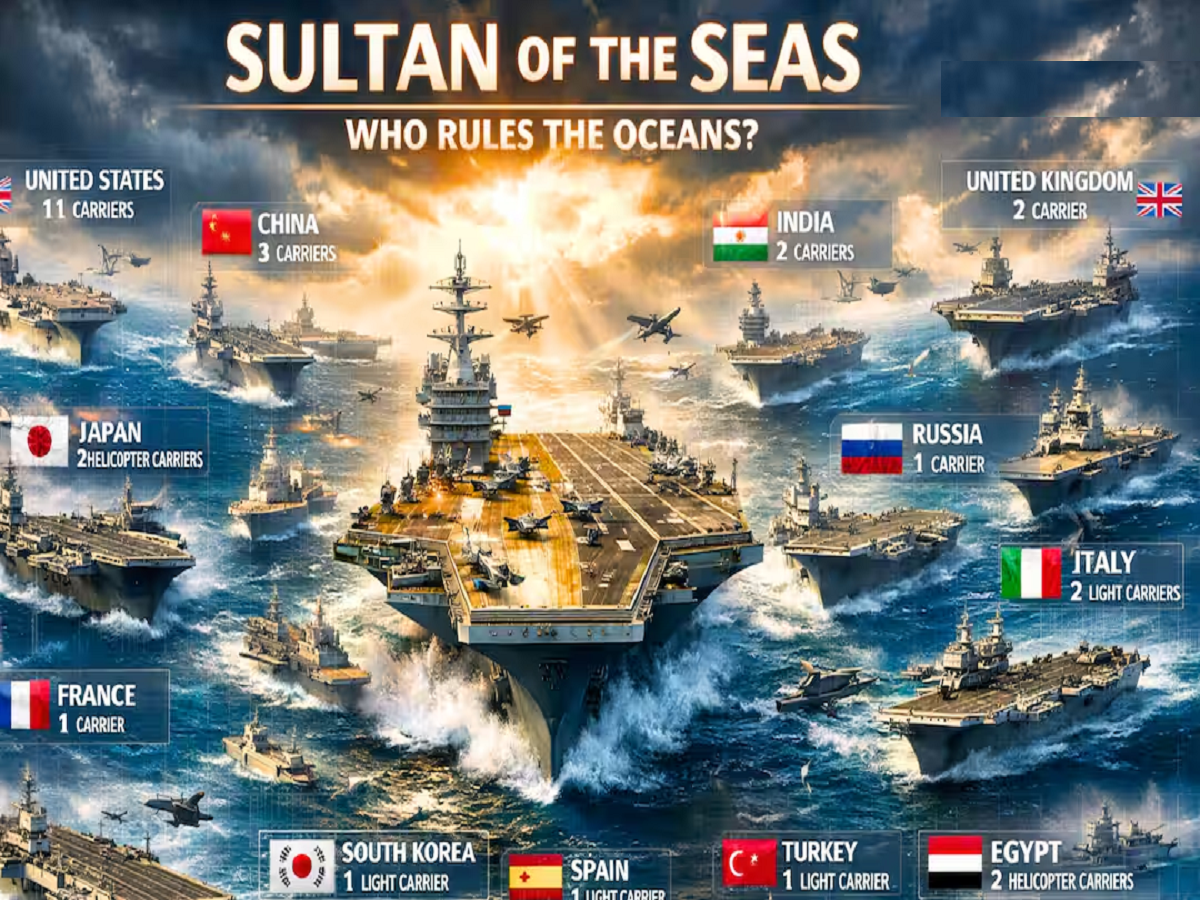
World Aircraft Carrier: A total of 14 countries have aircraft carriers in 2026, ranging from conventional aircraft carriers to nuclear-powered and CATOBARs. Some carry helicopters or STOVL aircraft.
In the field of defense, the United States strives to demonstrate its dominance, which is not just visible in the air. When it comes to naval power, the United States emerges as the most powerful nation in the world. Recently, the United States has deployed its most powerful aircraft carrier, the USS Abraham Lincoln (CVN-72), in the Arabian Sea for several days. Meanwhile, preparations are underway to send another aircraft carrier, the USS Gerald R. Ford (CVN-78), considered the world's largest and most advanced aircraft carrier, to the Middle East.
Speaking of the US, it's important to know how many countries in the world have aircraft carriers, and how many more they have compared to the US. It's also important to understand India's position on this list. These aircraft carriers provide countries with maritime power, equipped with thousands of crew members and dozens of fighter jets and support aircraft. These ships play a vital role not only in warfare but also in power projection, sea control, deterrence, crisis response, and humanitarian assistance. By 2026, a total of 14 countries will have aircraft carriers, some conventional, some nuclear-powered, some Short Takeoff But Arrested Recovery (STOBAR) type, some Catapult Assisted Takeoff But Arrested Recovery (CATOBAR), and some Landing Helicopter Docks (LHDs) that carry helicopters or Short Takeoff Vertical Landing (STOVL) aircraft.
1. United States of America (11 carriers)
The US Navy's carrier aviation capabilities are unmatched. The Nimitz-class and Ford-class nuclear-powered supercarriers, along with the Wasp, Tarawa, and America-class amphibious assault ships, and several other amphibious vessels, enable the US to launch fighter jets and helicopters such as the F/A-18E/F, EA-18G, E-2D, F-35B, and F-35C. This provides the US with unparalleled sortie generation, global power projection, sea control, and deterrence. The US uses them for persistent campaigns, first-night strikes, ISR/C2 orchestration, and crisis response. These carriers are the most advanced in the world, capable of operating thousands of kilometers away and operating for extended periods on nuclear power. The US has more than twice the total deck space of the rest of the world, making it a maritime colossus.
America has the highest number of aircraft carriers, 11.
2. China (3 carriers)
The People's Liberation Army Navy (PLAN) currently operates three aircraft carriers: Liaoning, Shandong, and Fujian. China recently tested an advanced version of Fujian, equipped with a magnetic launching system. These carriers are conventionally powered, but Fujian features advanced catapult technology that allows for rapid aircraft launches. China is rapidly expanding its carrier fleet, and these ships carry J-15 fighter jets, helicopters, and other aircraft. They are used for territorial control in the South China Sea, power projection, and the defense of Chinese interests in the Indo-Pacific.
3. United Kingdom (2 carriers)
The UK operates the Queen Elizabeth-class carrier, consisting of two ships: HMS Queen Elizabeth and HMS Prince of Wales. Both carriers are conventionally powered and equipped with ski-jump ramps. Both can carry F-35B Lightning II STOVL-type fighter jets and helicopters. The UK uses its carrier capabilities for carrier strike groups, coalition operations, and deterrence patrols. These ships play a vital role in NATO operations and are used for global presence, such as in the Middle East or the Indo-Pacific.
4. India (2 careers)
India operates the INS Vikramaditya and Vikrant STOBAR carriers, which are capable of launching MiG-29K/KUB helicopters and, in the future, an indigenous platform. This provides India with capabilities to maintain presence in the Indian Ocean, conduct maritime control, fleet defense, and conduct limited strikes. India uses its carriers for deterrence patrols, exercises, and regional contingencies. INS Vikramaditya is a modified Kiev-class aircraft purchased from Russia, while INS Vikrant is India's first indigenous carrier, built at the Cochin Shipyard. Both carry MiG-29K fighter jets and helicopters such as the Kamov-31. India is considered to be ranked third or fourth in the world, but with two carriers, it holds a strong position in the Indo-Pacific. India plans to build more carriers in the future.
INS Vikrant is India's first indigenously built aircraft carrier.
5. Italy (1 carrier + 1 LHD)
Italy has a carrier, Cavour, and an LHD, Trieste. Both can launch F-35B Lightning II fighter jets and helicopters, providing flexible expeditionary air power and NATO interoperability. Italy uses these two ships for crisis response and coalition operations. Cavour is a light carrier designed for STOVL operations, while Trieste is a larger amphibious assault ship that can also handle fighter jets. These ships strengthen the Italian Navy in the Mediterranean and Atlantic.
6. Japan (2 carriers in conversion)
Japan is currently converting two Izumo-class ships, Izumo and Kaga, for short takeoff and vertical landing operations. Currently, the carriers are capable of launching helicopters, but after conversion, they will also be able to launch F-35B short takeoff/vertical landing (STOVL) aircraft. Japan uses its aircraft carrier capabilities for homeland defense reinforcement, island chain support, and alliance interoperability with the US and other Indo-Pacific partners. These ships are part of Japan's Pacific Defense Strategy.
7. South Korea (1 ship)
South Korea has a helicopter-centric Dokdo-class amphibious assault ship. However, there are plans to incorporate F-35Bs or other STOVL-type fixed-wing aircraft in the future. Currently, Dokdo is limited to helicopters only. Dokdo enables amphibious operations, humanitarian assistance and disaster relief (HADR), and maritime lift. The ship is used for the defense of the Korean Peninsula and regional stability.
8. Spain (1 career)
Spain has an aircraft carrier, the Juan Carlos I LHD. It is equipped with AV-8N Harrier II fighter aircraft and various helicopters. This provides Madrid with STOVL strike, fleet support, and operational flexibility options. Spain uses Juan Carlos for operations in the Mediterranean Sea and the Atlantic Ocean. The ship is a key component of the Spanish Navy's Expeditionary Force.
9. Thailand (1 career)
Thailand has only one carrier, the Chakri Naruebet. Thailand's small aircraft carrier is the Chakri Naruebet. It previously launched Harrier aircraft, but the Royal Thai Navy has now retired those aircraft, so it now only launches helicopters. It is used more for disaster management and area signaling than for actual combat aircraft. This ship strengthens Thailand's Southeast Asian presence.
10. Turkiye (1 career)
Türkiye also has only one carrier, the TCG Anadolu amphibious assault ship. Türkiye's TCG Anadolu is equipped with helicopter aviation and carrier-oriented drones, but lacks manned fixed-wing platforms. This gives Türkiye the ability to experiment with sea-based ISR (Intelligence, Surveillance, and Reconnaissance) and strike operations in both the Black Sea and the Mediterranean. Türkiye has a long-standing geopolitical rivalry with its western neighbor and NATO ally, Greece. However, Anadolu is currently used for testing rather than actual warfare.
TCG is Anadolu Turkiye's only aircraft carrier.
11. Russia (1 career)
Russia has only one carrier, the Admiral Kuznetsov. It is Russia's sole aircraft carrier, often criticized for being in refit since 2017. It is uncertain whether the carrier will ever sail again due to its extensive problems. Launched in 1985 and formally commissioned into the Russian Navy in 1991, it has been notorious for countless mechanical and technical problems, frequent breakdowns, and cleaning difficulties. During its last operational service, the Admiral Kuznetsov launched Su-33 and MiG-29K fighters. It is a STOBAR type and supported the Russian Navy's global presence.
12. France (1 career)
France also has a carrier, the Charles de Gaulle, commissioned in 2001. This CATOBAR-equipped aircraft carrier is capable of launching Rafale M-2s, E-2C Hawkeyes, and helicopters. It provides true blue-water strike, nuclear deterrence signaling, and independent expeditionary air power. Significantly, France is the only naval power other than the United States to possess a nuclear-powered aircraft carrier. This ship is central to the French Navy's global operations.
13. Egypt (2 careers)
Egypt has two Mistral-class LHDs, which are considered carriers, named Gamal Abdel Nasser and Anwar Al Sadat. With the Mistrals, Egypt launches only attack, utility, or anti-submarine warfare mission-built helicopters. This enables amphibious operations, regional presence, and HADR. These ships provide Egypt with a robust presence in the Mediterranean and Red Sea.
14. Australia (2 careers)
Australia has two carriers, both Canberra-class LHDs, named HMAS Canberra and HMAS Adelaide. The Canberra-class only launches helicopters such as the MH-60R and occasionally Chinooks. This provides amphibious assault, HADR, command-and-control, and limited sea control support. Australia uses this capability for aviation lift and ISR in regional crises, disaster relief, and coalition amphibious operations, but not for strikes. These ships protect Australian interests in the Indo-Pacific.
These carriers not only enhance combat power but also aid diplomacy, disaster relief, and international cooperation. In total, there are approximately 25-30 such ships in the world in 2026, but the United States alone is more powerful than the rest of the world.
PC:ABPNews