BUSINESS
EPFO 3.0 to Enable Faster PF Transfers After Job Change, But These 5 Mistakes Can Still Delay Your Money
Employees changing jobs may soon experience a much smoother Provident Fund (PF) transfer process as the Employees' Provident Fund Organisation (EPFO) prepares to roll out its upgraded EPFO 3.0 digital platform. According to government updates, testing of the new system has been completed, paving the way for faster and more automated PF transfers between employers.
The upgraded platform aims to reduce paperwork and speed up the transfer of Provident Fund balances when an employee switches jobs. However, automation alone cannot guarantee instant transfers. Errors in employee records or incomplete documentation can still interrupt the process and delay access to your retirement savings.
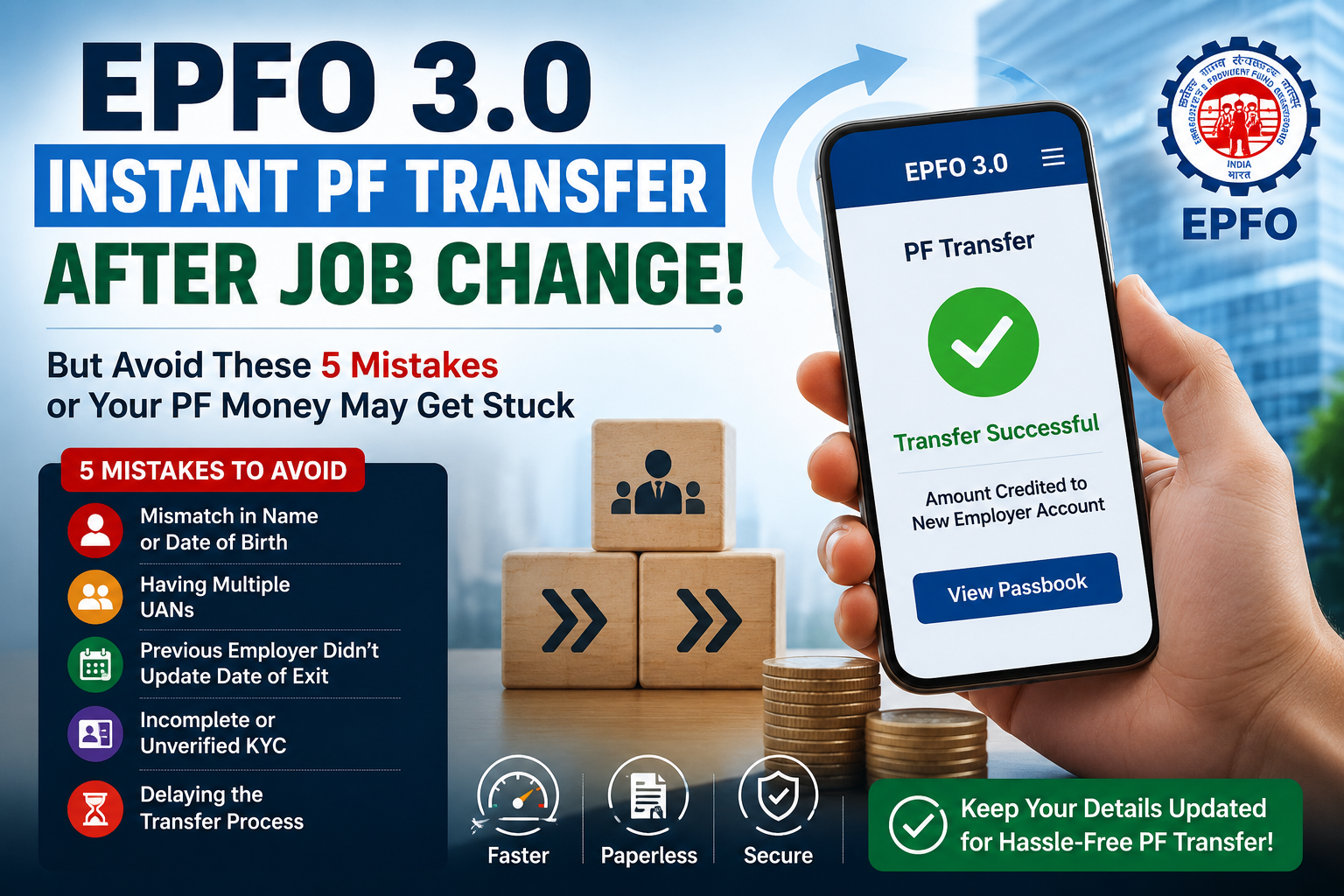
Here are the five most common mistakes that could prevent your PF balance from being transferred quickly under EPFO 3.0—and how you can avoid them.
1. Personal Details Do Not Match Across Records
One of the biggest reasons for PF transfer failures is inconsistent personal information.
If your name, date of birth, or other personal details differ across your Universal Account Number (UAN), Aadhaar, PAN or EPF records, the system may reject the transfer request during verification.
Before changing jobs, employees should carefully verify that all details are identical across every official document and the EPFO portal.
Correcting mismatched information in advance can help prevent unnecessary delays.
2. Having More Than One Active UAN
Many employees unknowingly end up with multiple Universal Account Numbers after joining a new employer.
Instead of using the existing UAN, a new employer may mistakenly generate another one, creating complications in the employee's EPF records.
Multiple active UANs require additional verification and account consolidation by EPFO before any transfer can be completed.
To avoid this issue, always provide your existing UAN to your new employer and confirm that it is being used for your new PF account.
3. Previous Employer Has Not Updated the Date of Exit
Even with a fully automated digital system, some responsibilities remain with employers.
The PF transfer process cannot begin unless the previous employer updates the employee's Date of Exit on the EPFO portal.
If this information is missing or delayed, the transfer request may remain pending indefinitely.
Employees should therefore confirm that their previous employer has completed all exit formalities, including updating the Date of Exit and submitting accurate wage records before completing the full and final settlement.
4. Incomplete or Unverified KYC
Many employees realize that their Know Your Customer (KYC) details are incomplete only when they try to transfer or withdraw their PF balance.
If Aadhaar, PAN or bank account details are not correctly linked and verified with the UAN, EPFO may place the transfer request on hold until verification is completed.
Before changing jobs, employees should log in to the EPFO member portal and ensure that all KYC details are:
-
Linked to the UAN.
-
Verified by the employer.
-
Updated with the latest information.
Completing KYC in advance can significantly reduce processing delays.
5. Delaying the Transfer Request
Some employees assume that their PF balance will automatically move to the new employer immediately after joining a new company.
Although EPFO 3.0 is expected to simplify and automate much of the transfer process, employees should still verify their employment details and ensure that the transfer request is initiated without unnecessary delay.
Waiting several months before checking the transfer status may increase the chances of discrepancies in employment records or documentation.
Timely verification remains an important step even under the upgraded system.
How EPFO 3.0 Is Expected to Improve the Process
The upgraded EPFO 3.0 platform is designed to make Provident Fund services faster, more digital and user-friendly.
The system is expected to:
-
Reduce manual intervention in PF transfers.
-
Enable faster processing after job changes.
-
Improve online verification of member records.
-
Minimize paperwork.
-
Deliver quicker service through enhanced digital infrastructure.
However, successful automation depends on the accuracy of the information available in the employee's records.
Tips for a Hassle-Free PF Transfer
Employees planning to switch jobs can improve the chances of a smooth transfer by following a few simple precautions:
-
Verify personal details across Aadhaar, PAN and UAN.
-
Use only one active UAN throughout your career.
-
Ensure your previous employer updates the Date of Exit.
-
Complete and verify all KYC details before resigning.
-
Monitor your EPFO account after joining the new employer and promptly verify employment information.
Final Takeaway
EPFO 3.0 promises to make Provident Fund transfers significantly faster by introducing a more advanced digital system. While the technology is expected to reduce delays and simplify the process, the responsibility for maintaining accurate records still rests with employees and employers alike.
Incorrect personal details, duplicate UANs, incomplete KYC, delayed employer updates and late transfer requests remain the most common reasons for processing delays. Taking a few preventive steps before changing jobs can help ensure that your PF balance moves seamlessly to your new account without unnecessary interruptions.
Disclaimer: This article is intended for informational purposes only. EPFO procedures and digital services may evolve over time. Employees should refer to official EPFO notifications or consult their employer's HR department for the latest guidelines regarding Provident Fund transfers.