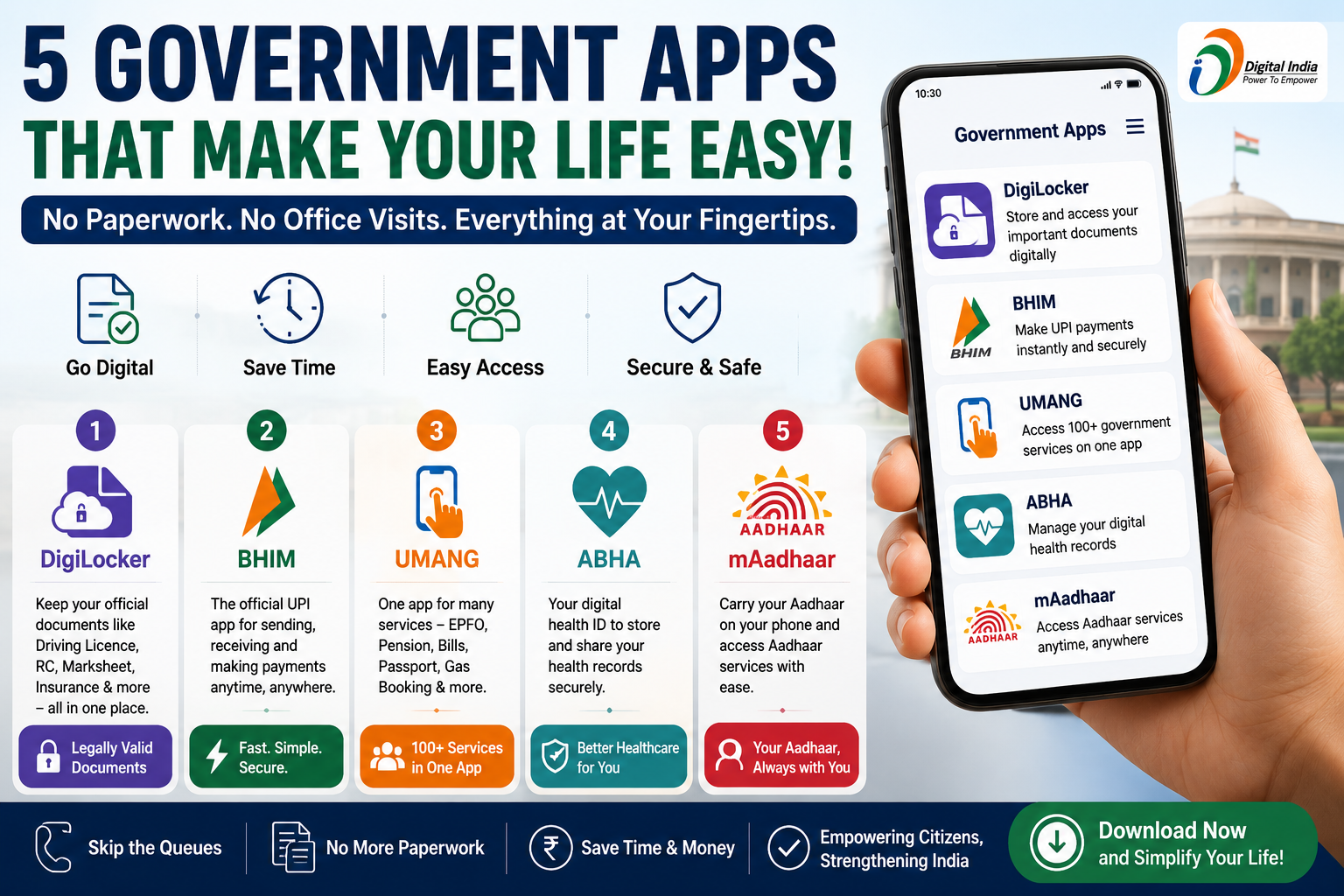
Managing everyday government-related tasks has become much easier with the growing adoption of digital public services in India. From storing official documents and making UPI payments to checking Provident Fund details and accessing healthcare records, several government-backed mobile applications now allow users to complete essential tasks directly from their smartphones.
Instead of visiting multiple offices or carrying physical documents, citizens can use these apps to access important services securely and conveniently. Whether you are a student, salaried employee, business owner or frequent traveler, installing these government apps can help simplify daily life.
Here are five government apps that every smartphone user should consider downloading.
1. DigiLocker: Store and Access Your Important Documents Digitally
DigiLocker is one of India's most widely used digital document storage platforms.
The app allows users to securely access digital versions of important government-issued documents, including:
-
Driving Licence
-
Vehicle Registration Certificate (RC)
-
Academic Certificates
-
Insurance Documents
-
Identity Proofs
Documents issued or verified through DigiLocker are legally recognized under government regulations and are accepted by many public and private organizations.
This eliminates the need to carry physical copies of documents in many situations.
DigiLocker is particularly useful for:
-
Students applying for admissions.
-
Job seekers.
-
Frequent travelers.
-
Individuals attending government verification processes.
2. BHIM: A Simple and Secure UPI Payment App
BHIM (Bharat Interface for Money) is a government-backed Unified Payments Interface (UPI) application designed for fast and secure digital payments.
Using BHIM, users can:
-
Transfer money instantly.
-
Receive payments.
-
Scan and pay through QR codes.
-
Pay merchants.
-
Manage multiple bank accounts linked to UPI.
Because it operates on the UPI network, transactions can be completed around the clock without visiting a bank.
The app offers a simple interface for users who prefer a straightforward digital payment experience.
3. UMANG: Hundreds of Government Services in One App
Rather than downloading separate applications for different government departments, UMANG (Unified Mobile Application for New-age Governance) brings multiple public services together on a single platform.
Through UMANG, users can access services related to:
-
EPFO
-
Pension schemes
-
Utility bill payments
-
LPG gas booking
-
Passport services
-
Government certificates
-
Various central and state government departments
The app helps reduce paperwork and saves considerable time for citizens who regularly interact with government services.
For many users, UMANG acts as a one-stop digital gateway for public services.
4. ABHA: Manage Your Digital Health Records
ABHA (Ayushman Bharat Health Account) is part of India's Digital Health Mission.
The application allows users to create a unique digital health ID that securely stores and manages medical records.
With ABHA, participating hospitals and healthcare providers can access authorized medical information electronically, helping improve continuity of treatment.
The app is especially beneficial for individuals who:
-
Receive long-term medical treatment.
-
Visit multiple hospitals.
-
Want centralized access to their health records.
-
Prefer digital management of medical information.
It reduces the need to carry physical medical files during consultations.
5. mAadhaar: Aadhaar Services on Your Smartphone
The mAadhaar app enables users to keep a digital version of their Aadhaar card on their mobile device.
In addition to storing Aadhaar details, the application offers access to several Aadhaar-related services, including:
-
Viewing Aadhaar information.
-
Updating eligible profile details.
-
Locating Aadhaar enrolment centres.
-
Identity verification using the digital Aadhaar profile.
The app provides quick access whenever Aadhaar-based identification is required, making it a convenient alternative to carrying a physical Aadhaar card.
Why These Apps Are Useful
Each of these applications serves a different purpose, but together they cover many of the most common services people use in their daily lives.
With these apps, users can:
-
Reduce paperwork.
-
Access government services online.
-
Save time by avoiding unnecessary office visits.
-
Manage documents securely.
-
Complete financial and identity-related tasks digitally.
As government services continue to become more digital, these applications can help citizens complete many routine tasks more efficiently.
Frequently Asked Questions
Are documents stored in DigiLocker legally valid?
Yes. Documents that are issued or verified through DigiLocker are legally recognized under applicable government rules and are accepted by many public and private institutions.
Is BHIM different from other UPI apps?
BHIM uses the same UPI infrastructure as other payment applications. Its primary focus is to provide a simple, secure and government-backed platform for sending and receiving money.
Can UMANG completely eliminate visits to government offices?
For many services, the answer is yes. However, certain procedures may still require physical verification, submission of original documents or in-person visits depending on departmental requirements.
Final Takeaway
Government-backed digital applications have significantly simplified access to public services in India. Whether you need to store important documents, make instant payments, check your EPF account, manage medical records or access Aadhaar services, these five apps can help you complete essential tasks quickly and securely.
By using these digital platforms, citizens can save time, reduce paperwork and minimize unnecessary visits to government offices while accessing a growing range of services directly from their smartphones.