TECH
AI Chips Are Getting Smarter: How Microsoft's New Maia 300 Could Change the Future of Cloud Computing
Artificial intelligence is transforming how people work, communicate and use digital services. Behind every chatbot response, AI-generated image and automated business task, however, lies a massive computing infrastructure that consumes electricity and requires powerful processors.
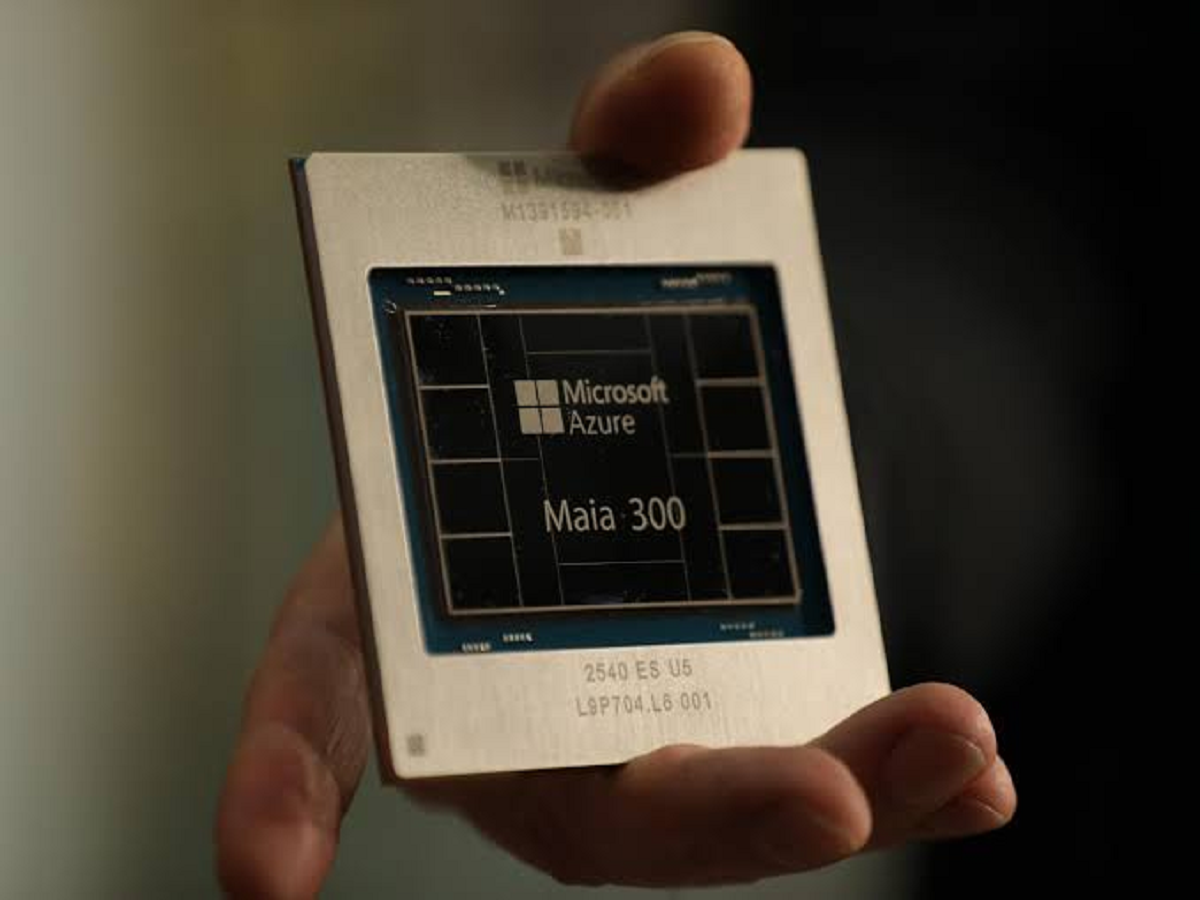
As demand for AI services continues to grow, technology companies are racing to develop specialised chips that can deliver AI responses faster and more efficiently. Microsoft is the latest major player pushing further into this field with its Maia 300, a custom AI accelerator designed to power large-scale AI workloads.
The announcement highlights a significant shift in the technology industry: instead of relying entirely on processors from external suppliers, major cloud companies are increasingly developing their own hardware to support the next generation of artificial intelligence.
What Is Microsoft's Maia 300 Chip?
Microsoft's Maia 300 is a third-generation custom AI chip designed primarily for inference workloads. Inference is the process through which a trained AI model generates responses, analyses information or produces content in response to a user's request.
For example, when someone asks an AI assistant to summarise a document or generate computer code, the underlying model must perform calculations to produce the answer. Specialised AI accelerators can help carry out these calculations at scale.
Microsoft plans to use Maia 300 as part of its AI infrastructure, supporting services and platforms such as Copilot, Teams, GitHub and its broader AI development ecosystem.
The company has described the chip as a major investment in its own silicon technology, signalling its intention to gain greater control over the hardware powering its AI services. Production is planned for 2027.
Why Are Technology Companies Building Their Own AI Chips?
For years, many technology companies have depended heavily on processors supplied by specialist semiconductor manufacturers. However, the explosive growth of AI has made computing hardware a strategic priority.
Developing custom chips offers several potential advantages.
1. Better control over performance
Companies can design processors around the specific workloads their services need to handle. This can help them optimise performance for tasks such as generating text, processing images and running AI agents.
2. Potentially lower operating costs
Running AI services requires substantial computing resources. A more efficient chip could help reduce the cost of processing each request, although the actual savings depend on manufacturing costs, infrastructure design and workload performance.
3. Greater control over supply chains
Developing in-house processors can reduce dependence on a single external supplier and give cloud companies more flexibility when expanding their infrastructure.
4. Improved energy efficiency
AI data centres consume significant amounts of electricity. Hardware designed for particular workloads may improve the amount of computing delivered per unit of energy, helping operators manage both electricity costs and infrastructure demands.
These advantages are potential outcomes rather than guaranteed results. Custom chips must still compete on reliability, software compatibility, availability and total cost.
How Could Maia 300 Affect Everyday Users?
Most consumers will not purchase Maia 300 as a standalone computer component. Its impact is more likely to be felt indirectly through the online services that use it.
If specialised AI infrastructure becomes more efficient, cloud providers may be able to process more requests with the same resources. This could support faster responses, additional AI features and more affordable services over time.
For businesses using cloud-based AI tools, improvements in infrastructure could also make it easier to deploy AI applications across larger teams.
However, the real-world benefits will depend on how the chip performs after deployment, how widely it is adopted and how Microsoft integrates it into its services.
The Growing Competition in AI Hardware
Microsoft is not alone in developing custom AI processors. Major technology companies are investing in specialised hardware because general-purpose processors may not always provide the most efficient solution for every AI workload.
The competition involves more than raw processing speed. Memory bandwidth, power consumption, networking, software tools and the ability to operate large groups of chips together can all influence performance.
This is especially important because modern AI systems often run across thousands of processors working together in large data centres.
The companies that can combine efficient chips with reliable software and large-scale infrastructure may gain an advantage in delivering AI services.
Can Custom AI Chips Reduce the Cost of Artificial Intelligence?
Potentially, but lower hardware costs do not automatically translate into cheaper AI subscriptions or free services.
The overall cost of an AI system includes chip development, data-centre construction, electricity, cooling, networking, software engineering and ongoing maintenance.
Even if a new processor improves efficiency, companies must recover the costs of developing and operating their infrastructure. Pricing decisions will also depend on competition and customer demand.
For consumers, the more immediate benefit may be improved service performance or the availability of features that would otherwise be too expensive to operate at scale.
What Challenges Lie Ahead?
Developing an AI chip is a complex engineering challenge. The processor must perform efficiently under demanding workloads while working reliably with memory systems, networking equipment and software frameworks.
Manufacturing capacity is another consideration. Advanced chips require sophisticated production facilities, and large-scale deployment depends on the availability of suitable components and packaging technology.
Software compatibility also matters. Developers need tools that allow them to use the hardware effectively without having to redesign every application from scratch.
Microsoft will therefore need to demonstrate not only that Maia 300 can perform well in technical tests, but also that it can deliver dependable benefits in real-world AI infrastructure.
The Future of AI May Depend on the Chips Behind It
The next phase of artificial intelligence will be shaped not only by more capable AI models, but also by the infrastructure required to run them.
Microsoft's Maia 300 reflects a broader industry trend towards custom AI hardware designed for the growing demands of cloud computing. If the technology delivers on its intended goals, it could help Microsoft improve the efficiency and scale of its AI services.
For ordinary users, the chip itself may remain invisible. Its significance will be measured by what people experience when using AI: faster responses, more capable applications and services that can operate efficiently at a much larger scale.
The future of AI is therefore as much about the processors powering it as it is about the intelligence of the software running on them.