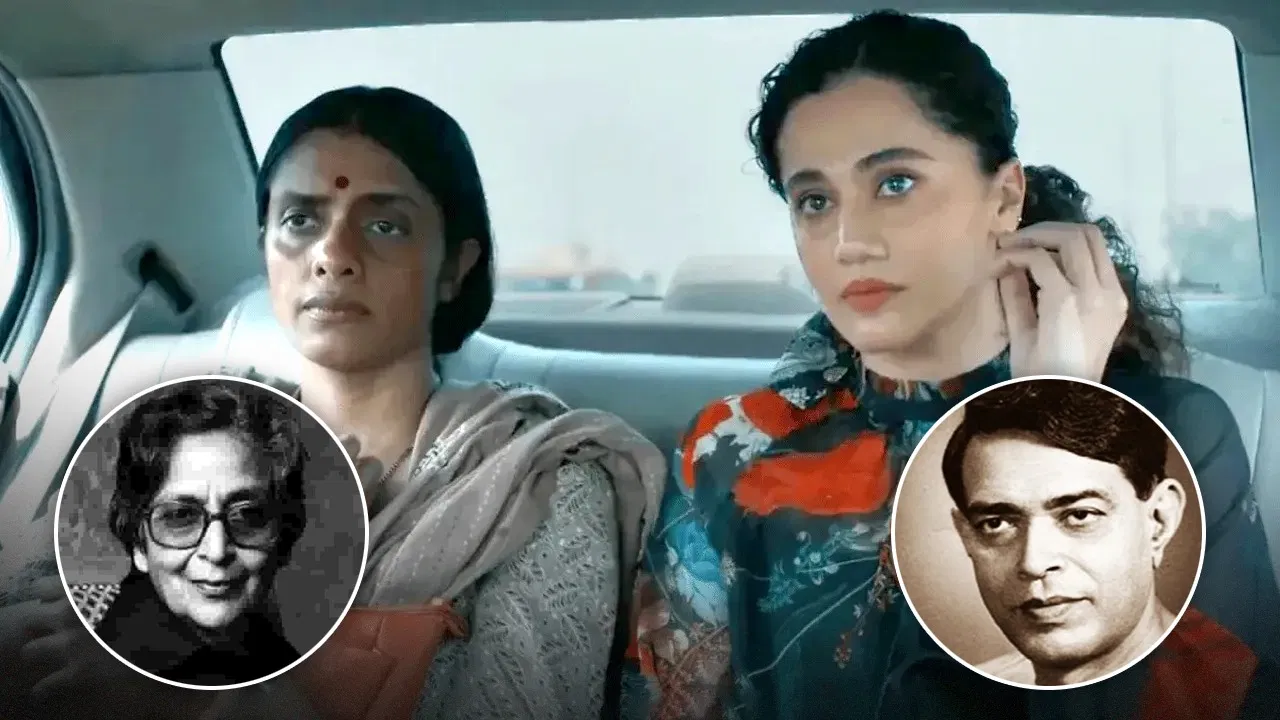
When Inspector Sanjay asks the rape accused, “What did Ramdhari Singh Dinkar write?” and later mentions Vinod Kumar Shukla, Amrita Pritam, and Ismat Chughtai, the accused responds by saying they are “lying” or claims he doesn’t know them at all.
This moment has three layers of meaning:
1. Moral Illiteracy, Not Just Legal Guilt
The inspector is a literature lover. By invoking poets and writers, he is silently asking:
“Have you ever been exposed to ideas that teach empathy, dignity, resistance, and humanity?”
-
Ramdhari Singh Dinkar represents moral courage and ethical nationalism
-
Amrita Pritam represents pain, compassion, and human cost of violence
-
Ismat Chughtai represents questioning patriarchy and sexual hypocrisy
The accused not knowing them isn’t about education—it signals emotional and ethical illiteracy.
The film suggests that brutality is born not only from crime, but from a complete absence of cultural and moral inheritance.
2. Literature as a Measure of Sensitivity
Even if the accused had known these writers, the question would still be disturbing.
But not knowing them at all shows a deeper crisis:
A society that produces individuals untouched by art, literature, or thought will also produce violence.
The inspector’s disappointment is not professional—it is existential.
He is confronting a human being who has never learned to feel.
3. Silence Is Also Violence: Uday Prakash’s Poem
Later in the courtroom scene, lawyer Ravi (played by Taapsee Pannu) references a poem by Uday Prakash:
“When a man dies, he says nothing, thinks nothing…
The one who says nothing, thinks nothing, is dead.”
This isn’t aimed at the criminal—it’s aimed at society.
The poem indicts:
-
People who stay neutral
-
People who look away
-
People who say “this doesn’t concern me”
According to the film, such people are morally dead, even if biologically alive.
Why does the screen turn red every 20 minutes?
Every 20 minutes, the screen turns red to remind viewers that another rape has statistically occurred in that time.
The message is brutal and intentional:
-
Laws exist
-
Protests happen
-
Debates continue
Yet violence persists.
So the film asks: Where are we failing?
“Top results, but the school has failed”
This final metaphor is crucial.
The film says:
-
We celebrate laws, convictions, statistics (top results)
-
But fail at education, values, empathy, upbringing (the school)
That failure creates:
-
Silent bystanders
-
Brutal criminals
-
Vigilante figures like Kartik (Kumud Mishra’s character)
None of which are solutions.
What Anubhav Sinha is really saying
Director Anubhav Sinha and writer Gaurav Solanki argue that:
-
Violence cannot be solved only by punishment
-
Justice cannot survive without cultural consciousness
-
Literature, art, and education are not luxuries—they are safeguards against cruelty
The Dinkar–Amrita Pritam dialogue is a warning:
A society that stops listening to its poets will eventually stop listening to its conscience.