BUSINESS
New Year Changes 2026: 10 Major Rules Set to Change From January, Including Pay Hike, Gas and Banking Updates
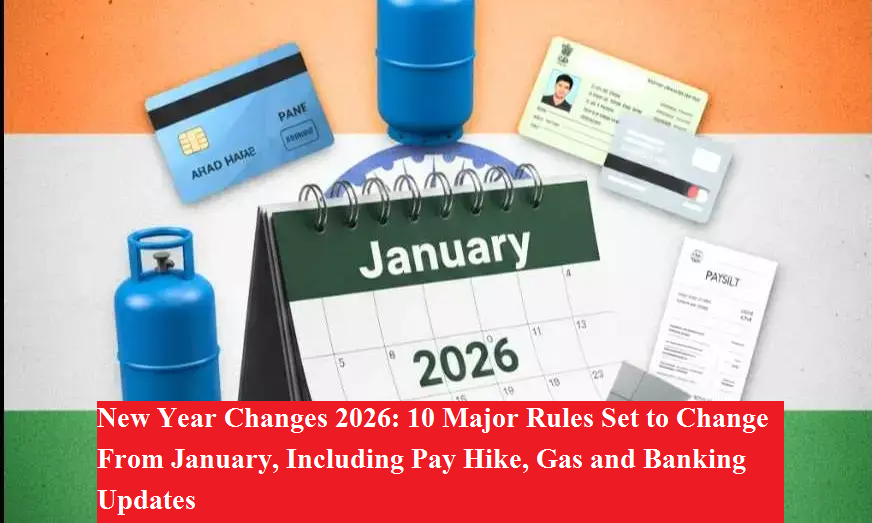
As the calendar turns to 2026, India is preparing for several major financial and regulatory shifts that will directly impact daily life, earnings, and household budgets. From salary structure updates to fuel prices and digital payment safeguards — the New Year will bring rules that every citizen should be aware of. Here’s a complete breakdown of the 10 key rule changes that may take effect starting January 1, 2026.
1️⃣ Cheaper Loans, Revised FD Interest Rates
Several leading banks have indicated that loan interest rates may be reduced early in the new year. This could make:
✔ Home loans
✔ Personal loans
✔ Auto loans
more affordable for borrowers.
At the same time, Fixed Deposit (FD) interest rates will undergo revision, meaning some banks may offer better returns, while others could reduce rates slightly depending on market trends.
2️⃣ 8th Pay Commission: Big Relief for Employees & Pensioners
The 8th Central Pay Commission is widely expected to take effect from January 1, 2026.
Potential benefits:
-
Salary and pension increases for central government employees
-
Revised allowances and fitment factor
-
Expected hikes between 20% and 35%, though official figures are awaited
-
Possibility of arrears in FY 2026–27
This could boost disposable income for millions of households.
3️⃣ PAN-Aadhaar Linking Becomes Compulsory
Starting January 2026:
-
PAN must be linked with Aadhaar to access most banking and government services
-
Unlinked PAN may be deactivated
-
Financial transactions, tax refunds, and benefits may be blocked
Citizens must complete the linking process before the deadline to avoid disruption.
4️⃣ Credit Score to Update Faster
Credit bureaus are updating their systems to reflect score changes weekly instead of once every 15 days.
Impact:
✔ Timely EMI payments will quickly improve credit scores
✔ Faster loan approvals
✔ Better interest rate eligibility for borrowers
5️⃣ CNG & PNG Prices May Drop
Upcoming changes in unified tariff policy may result in lower gas prices:
-
CNG may become cheaper by ₹1.25–₹2.50 per kg
-
PNG may drop by ₹0.90–₹1.80 per SCM
This move would reduce commuting and household cooking costs.
6️⃣ Stricter Rules for UPI and Digital Payments
To combat cyber fraud, the government will tighten:
-
UPI security measures
-
SIM card verification
-
Digital identity checks for users
Banks will use enhanced monitoring tools to detect suspicious transactions more quickly.
7️⃣ Social Media Age Restrictions for Minors
New safety guidelines are expected for children under 16 years of age, including:
-
Mandatory age verification
-
Stronger parental controls
-
Restrictions on harmful or risky online features
The goal is to improve digital safety for young users.
8️⃣ Restrictions on Older Petrol & Diesel Vehicles
Major metro cities may enforce stricter norms on:
-
Ageing petrol and diesel cars
-
Commercial fleets contributing to air pollution
This change could impact drivers, cab operators, and logistics companies.
9️⃣ Updated Rules for Farmers
New guidelines may require farmers to have a Unique Farmer ID to receive benefits under schemes like PM-Kisan.
Additionally, the Crop Insurance Scheme may expand coverage to include damage caused by wild animals — if reported within 72 hours.
🔟 Price Revisions for LPG, Aviation Fuel & More
As per monthly policy, fuel rates will be reviewed on January 1:
-
LPG cylinders
-
Commercial fuel
-
Aviation Turbine Fuel (ATF)
Any change — increase or discount — will immediately affect household and travel budgets.
The government could also introduce pre-filled ITR forms to make tax filing easier, though compliance rules may become more stringent.
Bottom Line
These changes reflect India’s move toward a more digitally secure, economically responsible, and environmentally conscious regulatory system. With new rules affecting everything from transportation to salaries and taxes, planning ahead will be key to managing expenses in 2026.