Systematic Investment Plans (SIPs) have become one of the most popular ways to invest in mutual funds, offering investors a disciplined approach to long-term wealth creation. However, many investors make the mistake of stopping their SIPs during periods of market volatility, often out of fear or uncertainty.
Financial experts generally believe that discontinuing investments prematurely may reduce the long-term benefits of compounding and limit the potential for wealth accumulation. Instead of reacting emotionally to short-term market movements, investors are encouraged to align their decisions with their financial goals and investment horizon.
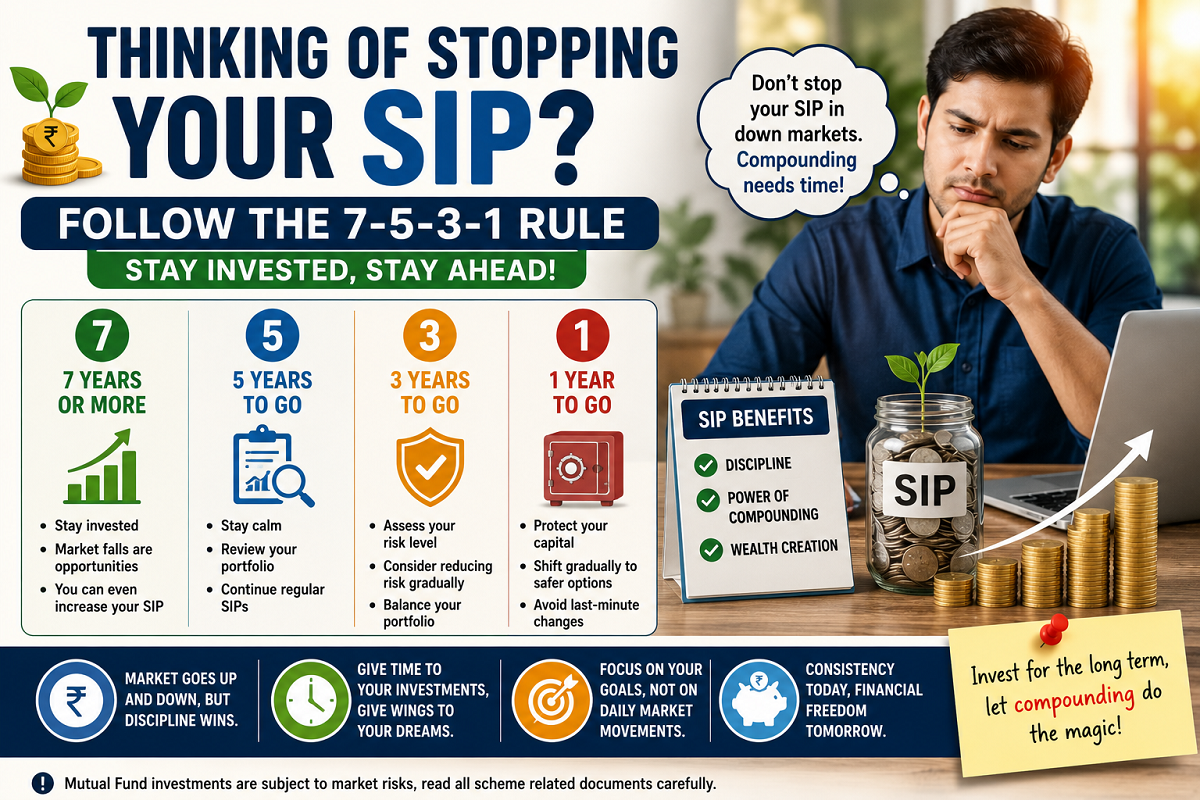
One concept often discussed in long-term financial planning is the 7-5-3-1 rule, which helps investors decide how to manage their investments based on the time remaining before they need the money.
Note: The 7-5-3-1 rule is a planning framework commonly used by some financial professionals. It is not an official regulatory guideline and should be applied based on individual financial circumstances.
Why Staying Invested Matters
One of the biggest advantages of investing through SIPs is the power of compounding.
When investments remain invested for a longer period, returns have more time to generate additional returns, allowing wealth to grow over time. Regular investing also helps reduce the impact of market volatility through rupee cost averaging, where investors purchase more units when prices are lower and fewer units when prices are higher.
Because of these benefits, many financial planners recommend continuing SIPs even during temporary market declines, provided the investment continues to match the investor's financial objectives.
Understanding the 7-5-3-1 Rule
The 7-5-3-1 rule is designed to help investors adjust their investment strategy according to the time left before reaching a financial goal.
If Your Goal Is More Than 7 Years Away
When your financial objective is still seven years or more in the future, market fluctuations are generally considered a normal part of long-term investing.
During this stage, experts often suggest:
-
Continuing SIP investments regularly
-
Avoiding panic during market corrections
-
Considering additional investments if appropriate and aligned with your financial plan
A longer investment horizon gives the portfolio more time to recover from short-term volatility.
If Your Goal Is Around 5 Years Away
When approximately five years remain before your financial goal, the focus should shift toward monitoring progress while maintaining investment discipline.
At this stage, investors may consider:
-
Reviewing portfolio performance periodically
-
Continuing regular SIP contributions
-
Rebalancing investments if required
-
Avoiding emotional decisions based solely on temporary market movements
The objective is to stay aligned with the original financial plan while ensuring the portfolio remains suitable for the goal.
If Your Goal Is About 3 Years Away
As the investment horizon becomes shorter, preserving accumulated wealth becomes increasingly important.
Many financial advisors recommend:
-
Evaluating the portfolio's risk level
-
Reducing exposure to highly volatile assets if necessary
-
Gradually adopting a more balanced investment approach
The exact strategy depends on the investor's financial objectives, risk tolerance, and overall asset allocation.
If Your Goal Is Just 1 Year Away
When the financial goal is approaching within a year, protecting accumulated capital often becomes the priority.
Some investors may consider gradually shifting a portion of their investments toward relatively lower-risk options, depending on their financial plan and advice from a qualified financial professional.
The aim is to reduce the impact that sudden market fluctuations could have on funds that may soon be required.
Don't Let Short-Term Market Volatility Dictate Long-Term Decisions
Market ups and downs are a normal part of investing in equity-oriented mutual funds.
History has shown that markets may experience periods of correction as well as recovery. Reacting impulsively by stopping SIPs during downturns may interrupt the long-term investment process and reduce the potential benefits of compounding.
Instead, investors should regularly review:
-
Their financial goals
-
Investment time horizon
-
Risk tolerance
-
Asset allocation
-
Overall financial plan
Discipline and Patience Are Key
Successful long-term investing is often built on consistency rather than trying to predict short-term market movements.
Maintaining regular SIP contributions, reviewing investments periodically, and making decisions based on financial goals rather than market emotions can help investors stay focused on long-term wealth creation.
The Bottom Line
The 7-5-3-1 rule serves as a useful framework for thinking about investment decisions based on the time remaining before a financial goal. Rather than stopping SIPs solely because markets become volatile, investors may benefit from adjusting their strategy according to their investment horizon and risk profile.
Before making significant investment decisions, it is advisable to consult a qualified financial advisor and ensure that your portfolio remains aligned with your long-term financial objectives.