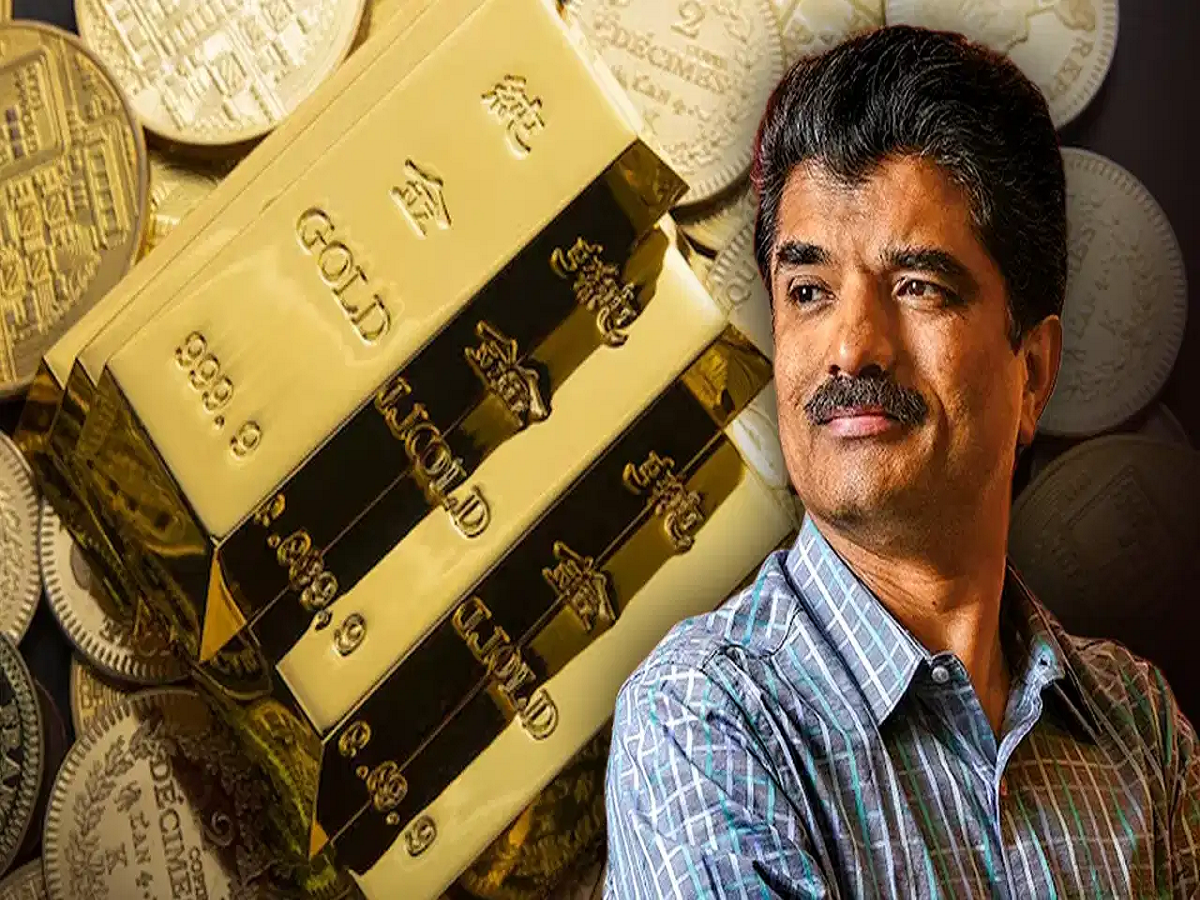
The fast-moving world of Indian business has seen its fair share of cinematic rises and sudden downfalls, but few match the current dramatic saga of Rajesh Mehta. Once revered as the country’s undisputed "Gold King," the billionaire founder of Rajesh Exports is now locked in a massive legal battle that threatens to dismantle his multi-billion-dollar global bullion empire.
On the evening of June 3, 2026, the Securities and Exchange Board of India (SEBI) dropped a regulatory bombshell, slapping a major market ban on Rajesh Exports and its promoter, Rajesh Mehta. The market watchdog has leveled stunning allegations of financial manipulation, accusing the company of artificially inflating its revenues by a jaw-dropping ₹15.15 lakh crore between the financial years 2020–21 and 2024–25.
The market reaction was instantaneous. As trading opened on the morning of June 4, 2026, panic-stricken investors rushed to dump their holdings, causing Rajesh Exports' shares to immediately tank 5%, hitting its lower circuit limit at ₹103.92.
The Gravity of the Allegations
What makes this regulatory crackdown so unprecedented is the sheer scale of the suspected numbers. SEBI's interim order alleges that the inflated revenue of ₹15.15 lakh crore represents roughly 99.80% of the entire total value stated by the company over those five financial years. Effectively, the regulator is questioning whether the bulk of the company's recorded business operations were merely an elaborate paper illusion.
Furthermore, investigators have openly accused the company management of refusing to fully cooperate with the ongoing probe. Given the severity of the suspected fraud, SEBI has barred Rajesh Mehta from the stock markets and ordered an intensive, independent forensic audit to trace the company's actual cash flows.
The Promoter’s Defense: Rajesh Mehta has vehemently denied all accusations of wrongdoing. Speaking out following the SEBI announcement, Mehta clarified that the directive is strictly an interim order based on unproven allegations. He stated that his legal and financial teams are thoroughly analyzing the text of the order and are preparing a comprehensive, formal response to challenge the restrictions in court.
The Garage Startup That Built a Global Monopoly
To understand why this controversy has sent such severe shockwaves through Dalal Street, one has to look at the legendary, movie-like foundation of the brand.
-
The Blueprint (1989): Rajesh Mehta started his entrepreneurial journey on a shoestring budget alongside his brother, Prashant Mehta. Their early business model was simple: they bought finished gold jewelry from commercial hubs in Chennai and traveled to Rajkot, Gujarat, to sell it to local merchants.
-
The Garage Workshop: Later that same year, they set up a microscopic jewelry manufacturing unit inside a tiny garage in Bengaluru. Through sharp commercial acumen and aggressive scaling, this humble workshop quickly morphed into an aggressive export house, shipping fine Indian gold jewelry to the UK, Dubai, Oman, Kuwait, the US, and across Europe.
-
The Forbes Peak: By 2019, Rajesh Mehta’s spectacular rise had landed him a coveted spot on the Forbes billionaires list, with his personal net worth estimated at $1.57 billion (roughly ₹14,915 crore at the time). Even through shifting market dynamics, the company reported a massive revenue of ₹2,516 crore as recently as March 2026.
The Swiss Masterstroke
The defining moment that catapulted Rajesh Exports from a prominent Indian exporter to a feared global powerhouse occurred in 2015. In a highly ambitious move that stunned the international bullion industry, Mehta acquired Valcambi SA, an incredibly prestigious, decades-old Swiss gold refining giant.
This single acquisition instantly turned Rajesh Exports into one of the largest gold refining ecosystems on the planet, with active corporate operational hubs spanning India, Dubai, and Switzerland. Boasting a massive, state-of-the-art refining infrastructure capable of processing up to 2,400 tons of gold products annually, the company's supply chains seamlessly stretched across more than 60 countries.