BUSINESS
8th Pay Commission Arrears: If you receive the 8th Pay Commission’s increased salary in January 2027, how much will your arrears be?

8th Pay Commission salary: Central government employees are wondering when the 8th Pay Commission will be implemented. Sources indicate that it may be implemented as early as January 1, 2026, but the increased salary may be received in January 2027. The question now arises: how much arrears will employees receive?
Calculation of arrears in the 8th Pay Commission
8th Pay Commission Implementation Date: January is over and 19 days have passed in February as well. In such a situation, the only question on the minds of all central employees is when will the 8th Pay Commission be implemented? According to sources, the recommendations of the commission formed for the 8th Pay Commission can be implemented from January 1, 2026, but for the increased salary, one may have to wait till January 2027. In such a situation, some employees are also asking that if the 8th Pay Commission is implemented from January 2027, then how much arrears will be there. Let us explain to you about this concept of arrears.
How is arrears calculated?
The calculation of arrears under the 8th Pay Commission is quite simple. The basis for arrears is the difference between the old basic salary and the new basic salary. Therefore, if the 8th Pay Commission is implemented in January 2027, arrears will apply for 12 months. This arrears amount will depend on the employee’s grade pay, basic pay, and fitment factor.
Let us know how much arrears will be received?
Let us understand the mathematics that if the 8th Pay Commission is considered to be implemented from January 2026 and the salary is received in January 2027, then how much arrears can the employees from Group A to D get.
Arrear calculation formula
Arrears = (New Basic Pay – Old Basic Pay) × Number of Months + (Difference in DA + HRA + Other Allowances) The fitment factor in the 8th Pay Commission is estimated to be approximately 2.86 to 3.0. This means the arrears could be approximately 2.9 times the basic pay.
Estimated Arrears (January 2026 to December 2026)
Group 7th Pay Commission Basic Pay (Average) 8th Pay Commission Estimated Basic Pay monthly difference 12 months arrears (Basic + DA only)
Group A ₹ 56,100 ~ ₹ 1,60,000 ~ ₹ 1,03,900 ~ ₹ 12.46 lakh
Group B ₹ 35,400 ~ ₹ 1,00,000 ~ ₹ 64,600 ~ ₹ 7.75 lakh
Group C ₹ 25,500 ~ ₹ 72,000 ~ ₹ 46,500 ~ ₹ 5.58 lakh
Group D ₹ 18,000 ~ ₹ 52,000 ~ ₹ 34,000 ~ ₹ 4.08 lakh
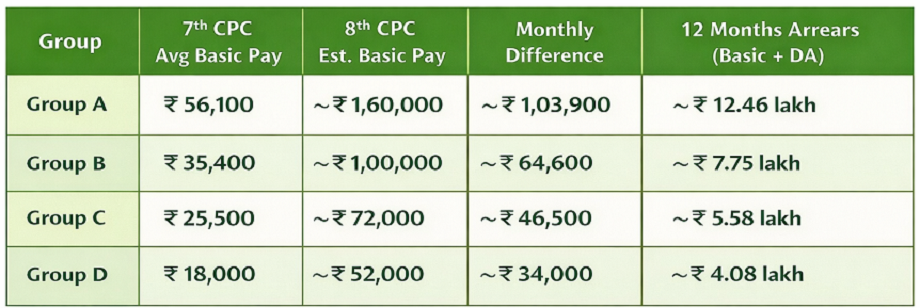
DA and HRA are not yet included in these. Therefore, the salary will increase further.
In such a situation, if the fitment factor exceeds 3.0, the arrears will increase further. Furthermore, DA changes every six months, and HRA and TA will also be recalculated based on the new basic pay, which could result in total arrears running into the lakhs.
Group A officers may get arrears of around Rs 12–15 lakh.
Up to Rs 7-9 lakh for Group B employees.
Up to Rs 5–6 lakh for Group C employees.
Group D employees can get arrears up to Rs 4 lakh.
What are the demands of the employees?
Regarding the 8th Pay Commission, employee organizations are demanding that the fitment factor be kept at 3.25. It should be noted that a fitment factor of 2.57 was implemented in the 7th Pay Commission. At that time, the basic salary had increased from Rs 7,000 to Rs 18,000. Amidst this demand of the employees, a major meeting regarding the 8th Pay Commission is going to be held in a few days. The drafting committee of the Joint Consultative Machinery of the National Council is going to meet on February 25th regarding the demands from the 8th Pay Commission. In this meeting, the demands of the employees will be placed before the Commission.
It should be noted that in November last year, the government constituted the 8th Pay Commission. This commission consisted of three members. The government also announced the commission’s chairman, members, headquarters, and working methods, i.e., Terms of Reference (TOR). According to a notification issued by the Department of Expenditure, Ministry of Finance, Justice Ranjana Prakash Desai has been appointed as the commission’s chairperson. In addition, Professor Pulak Ghosh has been appointed as a part-time member. Pankaj Jain will serve as the commission’s member secretary.
PC:Mint