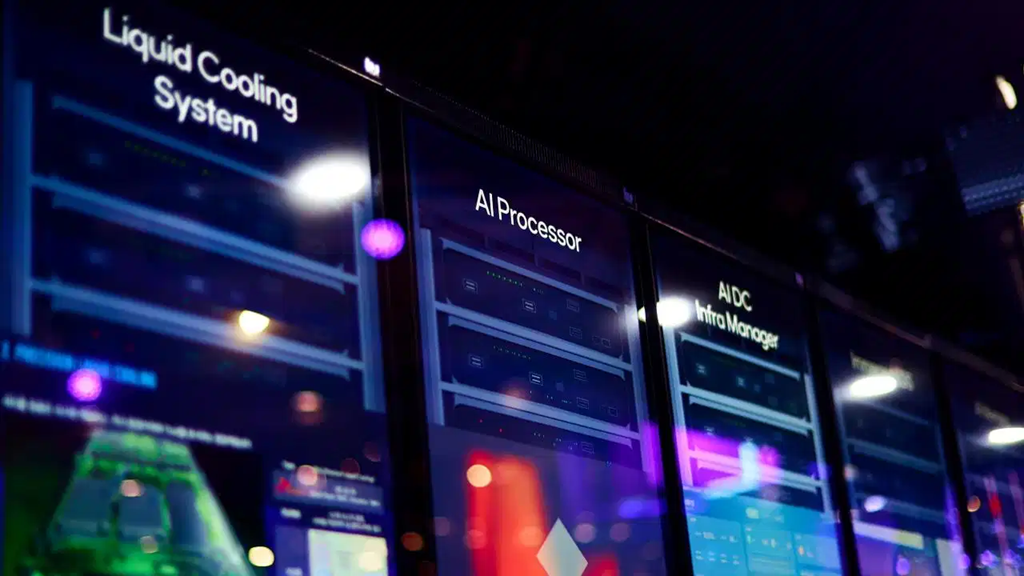
We are in the age of artificial intelligence, where massive AI models run on powerful servers packed inside large data centers. These facilities—often called “AI factories”—use thousands of high-performance GPUs and supercomputers that work continuously to process huge volumes of data.
But there’s a challenge: this level of computing generates extreme heat. Traditional air conditioning systems are no longer enough to keep these chips cool. That’s where liquid cooling comes in.
What Is Liquid Cooling?
Liquid cooling is an advanced heat management system used in modern data centers. Instead of relying only on air and fans, it uses specially engineered fluids (often dielectric liquids) to absorb heat directly from high-performance chips like GPUs and CPUs.
In simple terms, it works like a continuous heat-removal cycle:
-
Cool liquid flows through metal plates attached to chips
-
The liquid absorbs heat generated by processors
-
The heated liquid is sent to a heat exchanger
-
It is cooled again and recirculated
This closed-loop system keeps repeating, maintaining stable temperatures even under heavy AI workloads.
Why Air Cooling Is Not Enough Anymore
In traditional data centers, cooling systems like air conditioners and large fans consume a significant amount of electricity. In fact, cooling can account for up to 40% of total energy use in a data center.
As AI computing demand rises, this approach becomes inefficient, expensive, and environmentally unsustainable.
Liquid Cooling Saves Energy and Water
One of the biggest advantages of Liquid cooling is efficiency.
Compared to air cooling:
-
It reduces dependence on large air-conditioning systems
-
It uses small pumps instead of energy-heavy cooling units
-
It significantly lowers overall electricity consumption
-
It minimizes water waste in advanced closed-loop designs
Older systems often rely on evaporative cooling, which can consume large amounts of water. Modern liquid cooling systems, however, use closed-loop circulation, meaning the same liquid is reused continuously without evaporation.
Used in Next-Generation AI Hardware
Leading AI infrastructure is already adopting this technology. For example, NVIDIA’s upcoming AI systems are designed with full liquid cooling architectures, where even GPUs and networking components are cooled using liquid systems.
This enables higher computing performance while maintaining lower energy and water usage.
How It Helps the Environment
Liquid cooling is not just about performance—it also supports sustainability:
-
Reduces electricity consumption from cooling systems
-
Cuts down water usage significantly
-
Enables data centers to operate more efficiently in hot climates
The Bottom Line
As AI continues to grow, cooling technology becomes just as important as computing power. Liquid cooling is emerging as a critical solution that helps data centers run faster, cooler, and more efficiently—while also reducing environmental impact.