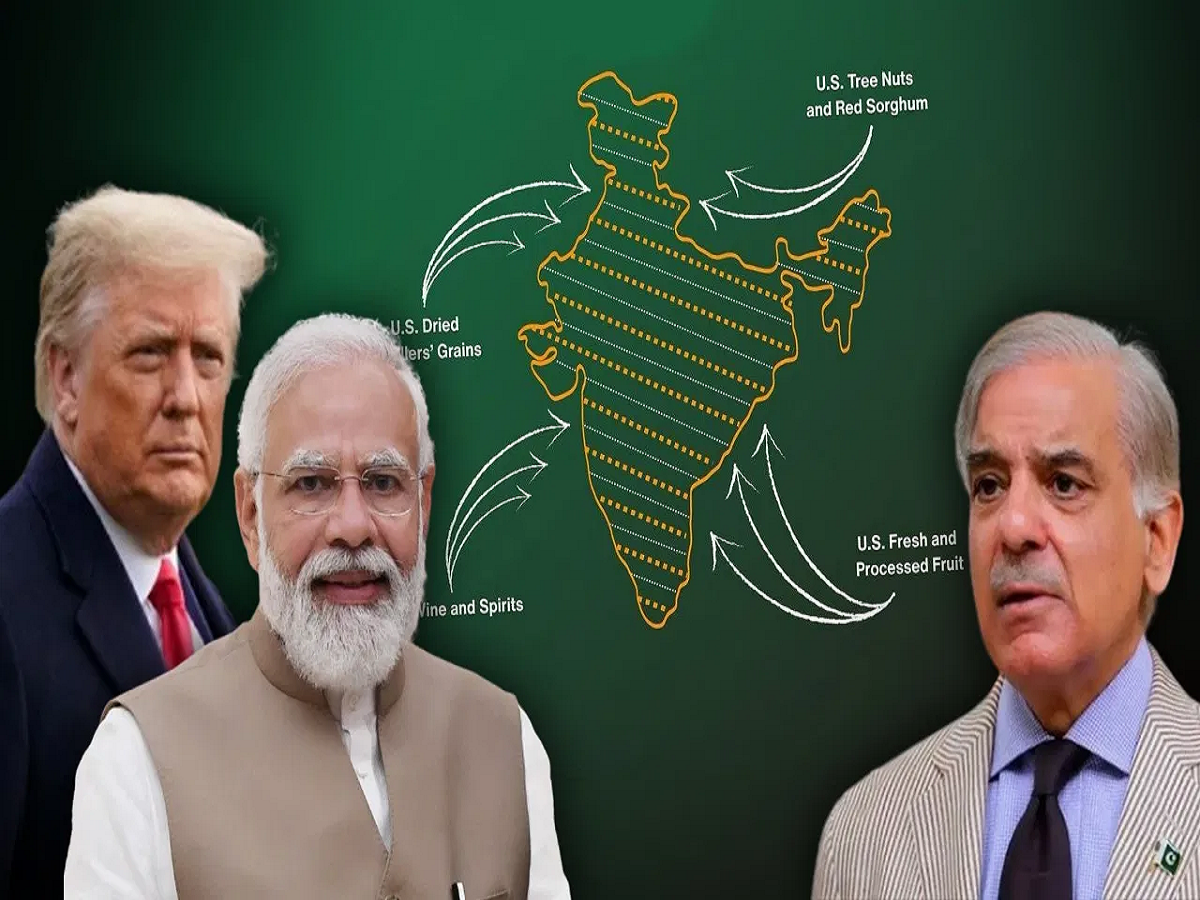
An interim trade agreement announced between India and the United States on Saturday has drawn attention for an unexpected reason—a map included in the official document released by the Office of the United States Trade Representative (USTR). Rather than tariffs or trade terms, it was the cartographic depiction of India that generated political ripples across South Asia and beyond.
The map shows the entire region of Jammu and Kashmir, including Pakistan-occupied Kashmir (PoK), as an integral part of India. It also depicts Aksai Chin, a territory claimed by China, within Indian borders. The representation has been widely interpreted as a diplomatic signal that has unsettled both Islamabad and Beijing, while being welcomed in New Delhi.
Departure from Past US Mapping Practices
Historically, US government publications have often portrayed PoK using dotted lines or marked it as a disputed territory, reflecting Washington’s cautious approach to the Kashmir issue. The latest USTR document, however, makes no such distinction. The clear depiction of Jammu and Kashmir as part of India marks a notable departure from previous practice.
This change has been seen as particularly uncomfortable for Pakistan, which has long objected to international maps that undermine its claim over PoK.
China Also Faces an Unwelcome Signal
China, too, appears affected by the map’s portrayal of Aksai Chin as Indian territory. Beijing has consistently claimed the region and has objected to similar depictions in international forums. India, for its part, has frequently raised concerns with foreign governments and global institutions over what it considers inaccurate representations of its territorial boundaries. In this instance, the US appears to have aligned more closely with India’s stated position.
Sensitive Timing Adds to Significance
The timing of the development adds further significance. India–US relations have faced strain in recent months, particularly after the Trump administration imposed tariffs of up to 50 percent on Indian goods—among the highest applied to any US ally. Under the interim trade arrangement, these tariffs have reportedly been reduced to around 18 percent, the lowest in Asia.
At the same time, criticism has emerged over renewed perceptions of US “hyphenation” between India and Pakistan. Against this backdrop, the inclusion of the map is being viewed in New Delhi as a subtle but meaningful diplomatic reassurance.
While neither Washington nor New Delhi has officially commented on the map’s implications, its inclusion has underscored how symbolism in official documents can carry strategic weight beyond formal agreements.