BUSINESS
Government Approves ₹23,731 Crore GOBARdhan Scheme, Farmers and Rural Entrepreneurs to Get a Big Boost
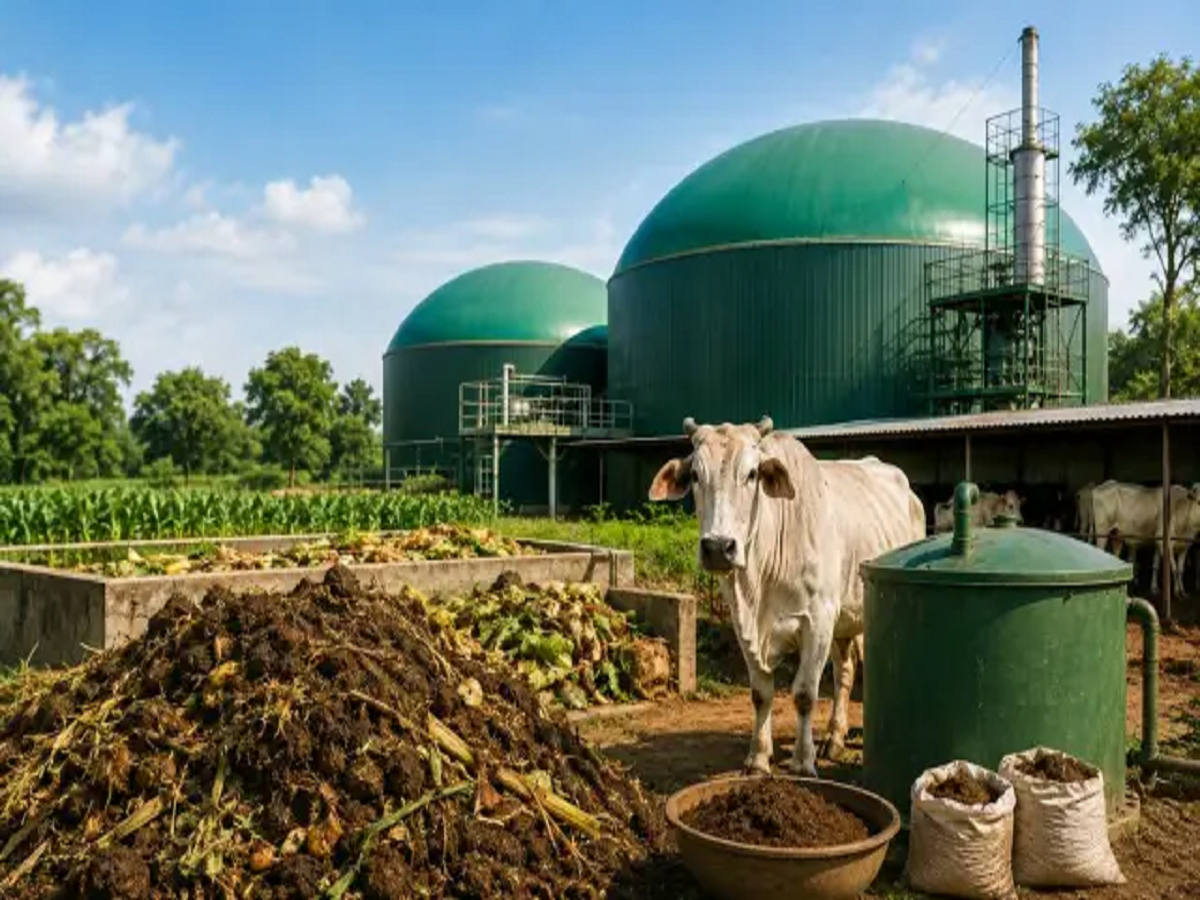
The government has approved a major new scheme aimed at turning agricultural waste, cattle dung and other organic waste into a source of clean energy and rural income. Called GOBARdhan, the National Circular Bioenergy Scheme, the programme has been approved with a total financial outlay of ₹23,731 crore.
The scheme will be implemented from 2026-27 to 2035-36 and is designed to significantly expand India's compressed biogas (CBG) sector.
What Is the GOBARdhan Scheme?
The main objective of GOBARdhan is to convert organic waste into useful products such as Compressed Biogas, organic manure and clean energy.
The scheme covers several types of waste, including:
-
Cattle dung
-
Agricultural residue
-
Press mud
-
Municipal organic waste
-
Other forms of biomass
Instead of allowing this waste to remain unused or become an environmental problem, the government wants it to become part of a larger circular economy.
Nearly 10 Times Growth in CBG Production
One of the biggest targets under the scheme is to increase India's domestic Compressed Biogas production by nearly ten times.
CBG can be used as a cleaner alternative to conventional gaseous fuels. Expanding domestic production could also help reduce India's dependence on imported fossil fuels and strengthen the country's energy security.
How Can Farmers Benefit?
The scheme could create new income opportunities in rural areas by giving agricultural waste and cattle dung an economic value.
Farmers and other rural participants can potentially benefit through the supply of biomass and organic material to CBG projects. The government also expects the scheme to create opportunities for feedstock aggregators, cooperatives and rural entrepreneurs.
This means agricultural residue that may otherwise have little economic value could become part of a new rural supply chain.
Support for Rural Entrepreneurs and MSMEs
GOBARdhan is not limited to large companies. The scheme includes measures designed to make it easier for MSMEs, women entrepreneurs and first-time project developers to participate in the CBG ecosystem.
A dedicated credit-guarantee mechanism will help improve access to institutional finance for eligible MSME-based CBG projects. The government expects this support to reduce financing difficulties and encourage more projects.
Government to Support Pipeline Connectivity
A major challenge for CBG plants is transporting the produced gas to markets.
Under the new scheme, the government will support pipeline infrastructure connecting CBG plants with trunk pipelines and City Gas Distribution networks.
Better connectivity is expected to reduce evacuation costs, improve reliability and allow CBG producers to reach a larger market.
More Than Just a Clean-Energy Scheme
The government is positioning GOBARdhan as a broader waste-to-wealth programme.
Apart from producing clean fuel, the scheme is expected to encourage the production and use of organic manure. It can also promote scientific management of agricultural residue, cattle dung and municipal organic waste.
The government expects the programme to generate new economic activity while helping reduce greenhouse-gas emissions through better utilisation of organic waste.
Scheme Will Run Until 2035-36
The GOBARdhan scheme will be implemented for a decade, covering the period from FY 2026-27 to FY 2035-36.
The long-term framework is intended to provide greater certainty to investors and project developers. It brings together measures such as assured demand, stable pricing, capital assistance, pipeline connectivity, credit support and technology development.
Why This Scheme Matters for Rural India
For rural India, the scheme could create a new economic value chain around resources that are already widely available.
Farmers can potentially earn from agricultural residue and other biomass, while rural entrepreneurs can explore opportunities in waste collection, transportation, processing, CBG production and organic manure.
With the government targeting a nearly ten-fold increase in domestic CBG production, GOBARdhan could become an important part of India's clean-energy and rural-development strategy over the next decade.