INTERNATIONAL
Why young people involved in Nepal's 'Gen Z' protests are now regretting it - Ground report
As soon as the flight landed at Tribhuvan International Airport in Nepal's capital Kathmandu, the first sight was of rain.
The clouds were visible so low and close that it seemed as if they had been given the additional responsibility of protecting the airport.
The airport was perhaps the only government establishment that remained unscathed during the Gen Z protests.
As soon as I stepped out of the airport, it felt like it was the calm after a big storm.
Empty roads, closed shops and strict vigil by young soldiers everywhere. In between, armoured army vehicles were running on the road.
It seems that Nepal's democracy has surrendered in two days of protests. The leaders had to run away to save their lives.
The entire Nepal is under the control of the Army since 10 pm on Tuesday night.
The vehicle in which we left the airport was stopped at several places by army personnel who assured us that we were from the press.
A friend from Nepal sitting next to me said – Welcome to Nepal.

Nepal's parliament was also set on fire on Tuesday
Media on target
Media was also targeted in the protest of 'Gen Z'. The office of Nepal's leading newspaper Kantipur was set on fire and turned into a ruin.
Supporters of Nepal's former Home Minister Rabi Lamichhane rescued him from jail during the 'Gen Z' protest.
The rest of the prisoners of Kathmandu's Nakkhu jail also escaped with Rabi Lamichhane. Prisoners have escaped from most of the jails in Nepal.
The smell of burning is still coming from the Nepal Parliament located in Baneshwor area of Kathmandu.
This parliament was a symbol of the end of the 239-year-old monarchy system in Nepal. This parliament was telling the story of democracy in Nepal for the last 17 years. But now smoke is rising from here.
Even when the people of Nepal abolished the monarchy in 2008, the Royal Palace Narayanhiti was not set on fire. Narayanhiti was converted into a museum and a Republic Memorial was built on the campus.
It seems that Monday and Tuesday of this week have overshadowed the democracy of the last 17 years.
There are abuses written on the walls of the Parliament in Devnagari in the name of KP Oli and Prachanda. When I was looking at these abuses written on the wall, a person from Nepal said in Nepali - Aisto Ghanti Ta Raja Ko Viruddh Pani Thi Na , meaning there was no such hatred even for the king.

Curfew has been imposed in Kathmandu and no consensus has been reached yet on the interim government
Anger on Indian media
Deepak Acharya, around 48 years old, is standing with his son outside the burnt Parliament. We were trying to talk to some women but they got very angry on hearing Hindi. Deepak said in English- Please stop it. Indian media are part of the Modi propaganda.
Deepak said this in such a loud voice that even the people around started looking at us. I tried to understand Deepak's anger and had a long conversation with him.
Deepak said, "Indian media is Godi media. Indian media is not only weakening its democracy, but is also involved in the funeral of our democracy. The people of Nepal will decide who will become the Prime Minister now, but Indian media is telling us that 'BHU ki beti' Sushila Karki will become PM. India's Godi media comes to Nepal as if Modi's rule is here too. Neither the Indian government sees Nepal as a sovereign and independent nation, nor the media there.
It is not just about Deepak Acharya. Anger towards the Indian media is very common in Nepal. Sometimes these things are in the form of rumours and sometimes people try to connect the incidents.
People here are also talking about external conspiracy and America's name is also being taken in this.
Image caption,The road department building in Kathmandu's Babermahal area has also been burnt down
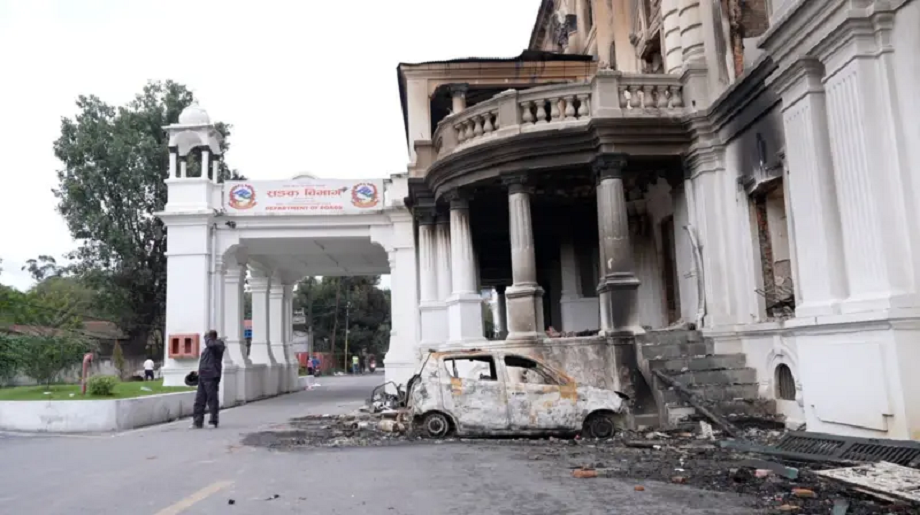
The road department building in Kathmandu's Babermahal area has also been burnt down
More confusion than solution
While we were standing outside the Parliament, two young men came on a scooter and started distributing water bottles and biscuits to the soldiers standing there. One introduced himself as Kishan Rauniyar and the other as Soman Tamang.
When asked why he is giving water and biscuits to the soldiers, Tamang said, "They are serving our country. We don't have much money but still we decided to do this. We run a salon."
Kishan Rauniyar is a Madhesi Hindu and Tamang is a Pahadi Buddhist. Both were involved in the protests. Kishan now regrets that too much destruction has happened.
Kishan said, "Every government building was set on fire. This was too much. We feel bad now. We are not even sure whether the next government that will be formed will be corruption free or not."
Many other people involved in the Gen Z protest now feel that destroying buildings was not right.
The anti-government wave that was created after the killing of 19 youth on Monday seems to be weakening a bit after Tuesday's incident. However, all the leaders of Nepal are still under house arrest.
It is about to be three in the evening and the curfew has been relaxed a little. People are coming out of their homes. We are standing in front of the Road Department building in Kathmandu's Babermahal area.
This was a very grand building but now smoke is coming out of its windows. There is also suffocation due to the smoke.
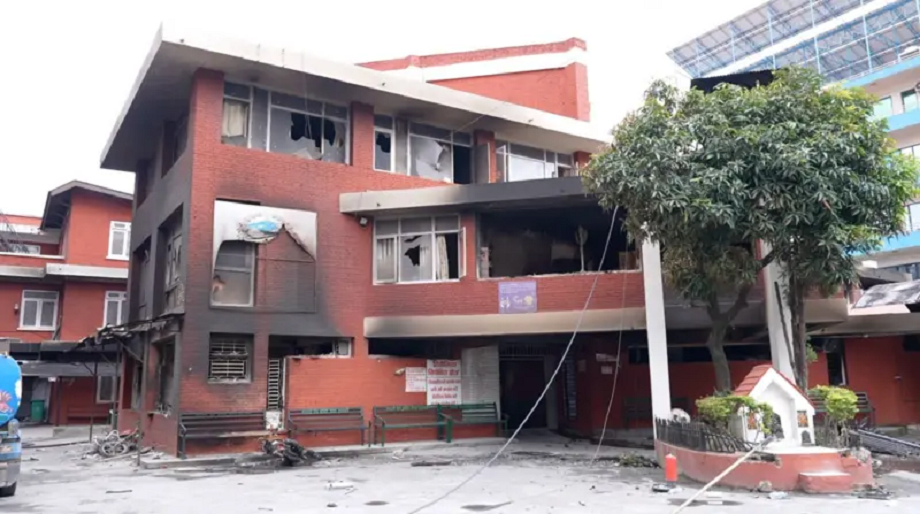
District office of Nepal, from where smoke is still rising
Nepal at the crossroads
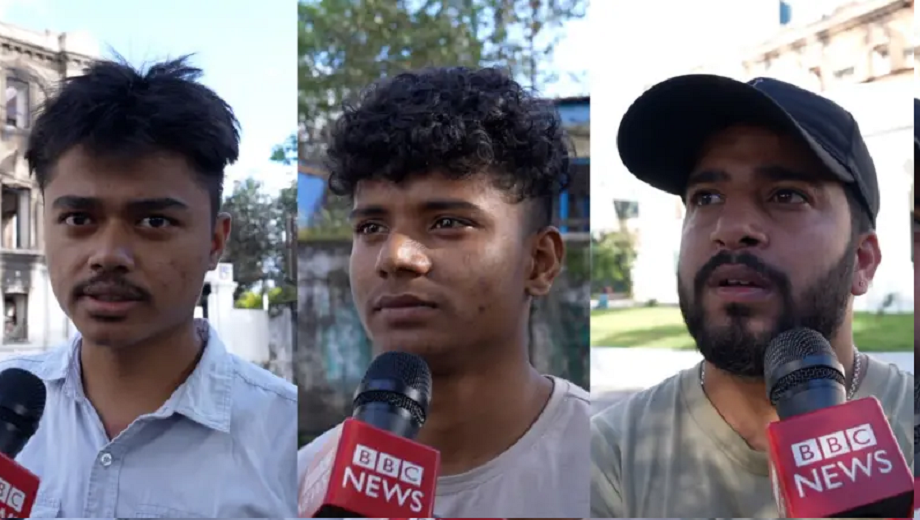
Here, three Gen Z protesters Nirajan Kunwar, Vishnu Sharma and Subhash Sharma are sitting in a very sad posture. All three are graduation students. Nirajan Kunwar was also injured in the protest.
Nirajan says, "We did not set fire to government buildings. It was other people. There has been a lot of destruction. To be honest, we are now regretting it. Nepal took a long time to build these buildings. We are very sad."
When Nirajan and Vishnu were asked who the other people were, they said that Ravi was a supporter of Lamichhane and RPP. The Rashtriya Prajatantra Party (RPP) is called monarchist and this party demands to make Nepal a Hindu nation.
Nirajan and Vishnu were asked whether they wanted a democratic Nepal or a monarchy? Do they want a secular Nepal or a Hindu nation?
Both of them openly said, monarchy system and Hindu nation. However, Subhash Sharma standing there said that he supports democratic Nepal.
Image caption,Vishnu Sharma is a graduation student in Kathmandu and was involved in the 'Gen Z' protest

Vishnu Sharma is a graduation student in Kathmandu and was involved in the 'Gen Z' protest
There was no universally accepted leader in this 'Gen Z' protest who could guide the youth about good and bad. So everyone did whatever they wanted.
If you talk to the youth, they seem completely confused.
Things are not very clear about how a civil government will be formed in Nepal now. The name of Sushila Karki, former Chief Justice of Nepal, is being taken but there is no consensus on this among the youth.
On Thursday, a faction of 'Zen Zee' was even protesting outside the Army Headquarters against the name of Sushila Karki.
The people of 'Gen Z' are asking Kathmandu Mayor Balen Shah to come forward but their demand is that the Parliament should be dissolved first. But why the Parliament should be dissolved and how, the answer to this is yet to be found in the Constitution.
Nepal stands at a crossroads.
There is no complete answer to the question as to how the people of Nepal, who have lived under monarchy for 239 years, will now take forward the 17 years of democracy.
Nepal is a landlocked country and it seems that its democracy is also surrounded by many crises.
PC:BBC