INTERNATIONAL
US Softens Its Stand on India: How Washington and Delhi Rewrote the Script of Strategic Friendship
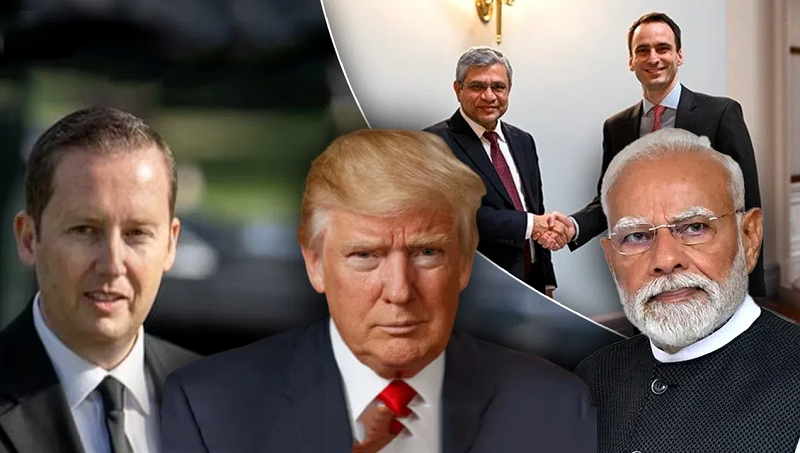
India–US relations have witnessed noticeable turbulence over the past few months, largely due to trade disagreements and sharp political messaging from Washington. US President Donald Trump’s tariff threats and repeated claims over ceasefires created friction, with the Trump administration pressing India to accept its conditions. However, the Modi government chose to hold its ground, refusing to yield to pressure. This firm stance from New Delhi appears to have prompted a visible shift in Washington’s approach over the past few days.
Tensions escalated further last week after US Commerce Secretary Howard Lutnick claimed that a trade deal failed because Prime Minister Narendra Modi did not call President Trump. India responded strongly to this assertion. The Ministry of External Affairs clarified that Prime Minister Modi and Trump had spoken by phone eight times in 2025, covering multiple aspects of bilateral ties. The ministry also stated that both countries had been engaged in trade negotiations since February 13 last year and were close to a deal on several occasions.
Even as India rejected Lutnick’s remarks, Washington appeared keen to contain the fallout. President Trump sent his envoy to Delhi, while senior officials worked in parallel to reinforce engagement. At the White House, Michael Kratsios, Director of the Office of Science and Technology Policy, met Union Minister Ashwini Vaishnav and India’s Ambassador to the US Vinay Mohan Kwatra. The discussions focused on technology cooperation and the upcoming AI Impact Summit to be hosted by India. Kratsios later indicated that further talks would continue in Delhi next month.
Vaishnav also participated in a key meeting hosted by US Treasury Secretary Scott Bessent, which focused on strengthening supply chains for critical minerals. Although the agenda centered on mineral security, the meeting was viewed as strategically important amid the recent strain in bilateral ties.
A significant signal of Washington’s intent to reset relations came with the arrival of the new US Ambassador to India, Sergio Gor, who formally assumed charge in Delhi. Emphasizing India’s importance, Gor said the country was the world’s largest nation and a crucial partner for the United States. He acknowledged that finalizing a trade deal would be challenging but stressed that Washington was determined to make progress, calling trade a central pillar of the bilateral relationship.
Describing himself as a close associate of President Trump, Gor said he had personally witnessed the rapport between Trump and Prime Minister Modi. He underlined that while true friends may disagree at times, they ultimately resolve their differences. Gor added that he had arrived in India with a clear mandate to take the India–US partnership to the next level and pursue an ambitious agenda in the coming months.
Signs of a policy rethink were also evident in Washington’s recent strategic decisions. In December, the US launched an initiative aimed at countering China’s dominance in global manufacturing supply chains but surprisingly excluded India, even as countries like Japan, South Korea, the UK, Israel, and Australia were included. This move raised concerns in New Delhi. Soon after, India extended an invitation to China for its AI Impact Summit, a development that reportedly prompted Washington to reassess its position. Within a month, the US reversed its earlier decision.
With diplomatic engagement intensifying, relations between India and the United States now appear to be back on a constructive path. Tuesday is expected to be crucial, as fresh rounds of trade negotiations are scheduled. Ambassador Gor has confirmed that both sides are actively negotiating and will meet again to push talks forward. After months of uncertainty, Washington and Delhi seem to be scripting a renewed chapter in their strategic partnership.