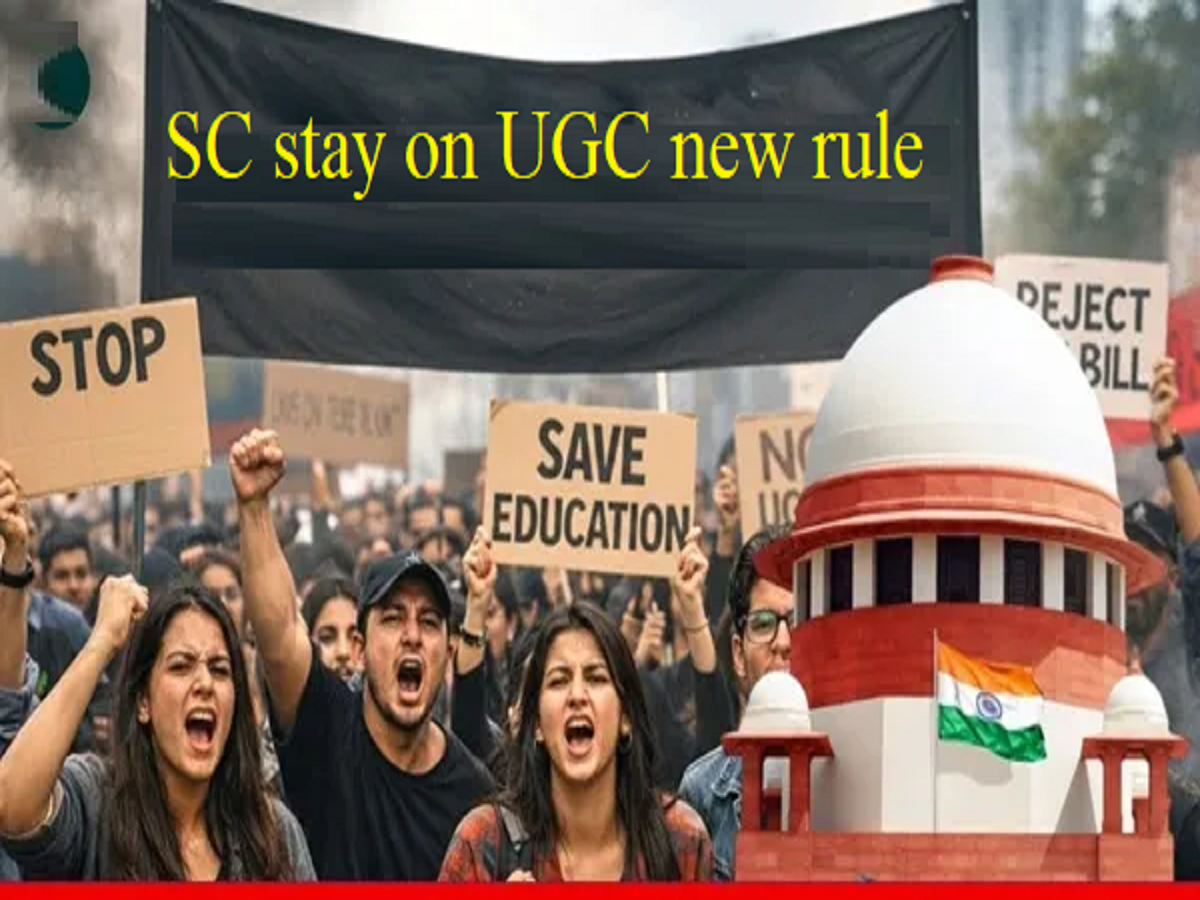
UGC New Rule Supreme Court: The Supreme Court has temporarily put a stay on the UGC's new anti-discrimination rules. Until further orders, the 2012 rules will remain in effect. During the hearing, the Supreme Court strongly remarked that the new UGC rules lack clarity.
The court issued a notice to the central government in this matter and temporarily stayed the implementation of these rules. The next hearing in this case will be held on March 19, 2026. A bench comprising Chief Justice Surya Kant and Justice Jyomalya Bagchi heard the case and delivered the verdict.
CJI said – UGC's new rules can be misused
During the hearing, the CJI stated clearly that the potential for misuse of these rules cannot be ruled out. During the hearing, CJI Surya Kant stated that the definition of discrimination in the new UGC rules should be broad and balanced. He remarked that the provisions related to caste are unclear, making the potential for misuse impossible.
#WATCH | On Supreme Court staying UGC Regulations 2026, Advocate Vishnu Shankar Jain, counsel of a petitioner, says, "Today, the Supreme Court heard our writ petition challenging the UGC Regulations which have been enacted recently. The Supreme Court has stayed the UGC… pic.twitter.com/1zk3vnZHiK
— ANI (@ANI) January 29, 2026
'Even a general category student can be vulnerable' (General Category UGC)
During the Supreme Court hearing of petitions challenging the new UGC regulations, serious concerns were raised by the petitioners. Counsel for one petitioner told the court that under the current regulations, general category students could be disadvantaged and exposed to false accusations.
UGC Ragging and Misuse of Law: Lawyer's Argument
Advocate Vishnu Shankar Jain argued that if a general category student is new to college, a senior can recognize them as a freshman by looking at them. This creates the risk of ragging. He argued that if the ragging senior belongs to a Scheduled Caste, the burden of complaint could fall entirely on the general category student.
The court questioned whether complaints of ragging would be considered under these new provisions. The lawyer replied no, as the rules removed the explicit definition of ragging. He argued that in such circumstances, a student has no effective legal recourse. Even anticipatory bail is no longer a viable option, and a false accusation could ruin a student's career.
Question on UGC definition of discrimination
Senior advocate Vishnu Shankar Jain, appearing for the petitioner, directly challenged Section 3C of the UGC Regulations, arguing that the definition of discrimination in this provision is incomplete and unbalanced, based solely on caste.
They argued that the Constitution grants all citizens the right to equality, but the UGC regulations discriminate only against certain classes. This completely excludes general category students, which is against the spirit of Article 14 of the Constitution.
The issue of the Constitution and social balance
Vishnu Shankar Jain argued that such a definition could increase division and animosity in society. He also argued that the new UGC regulations do not align with the broad interpretation of equality given in previous Supreme Court decisions.
During the hearing, a bench comprising Chief Justice Surya Kant and Justice Jyomalya Bagchi carefully heard all arguments. The main question before the court was whether the definition of discrimination should be so limited or should it be broadened to take into account the rights and protections of all students.
What is the objection in the UGC petition?
The petitioners argue that the new rules could discriminate against general category students. They argue that the rules' language and procedures are unclear, making them easy to misuse. This concern has sparked student protests in several states.
What is the provision in the new UGC rules
Under UGC regulations, the formation of equality committees is mandatory in all higher educational institutions. These committees require representation from OBCs, SCs, STs, women, and the disabled. Critics allege that this structure excludes general category students, leading to a prejudicial perception of them.
Government's stand and the way forward
Union Education Minister Dharmendra Pradhan has assured that the rules will not be misused and that no student will be discriminated against. All eyes are now on the next hearing in the Supreme Court, where the UGC rules will be decided.