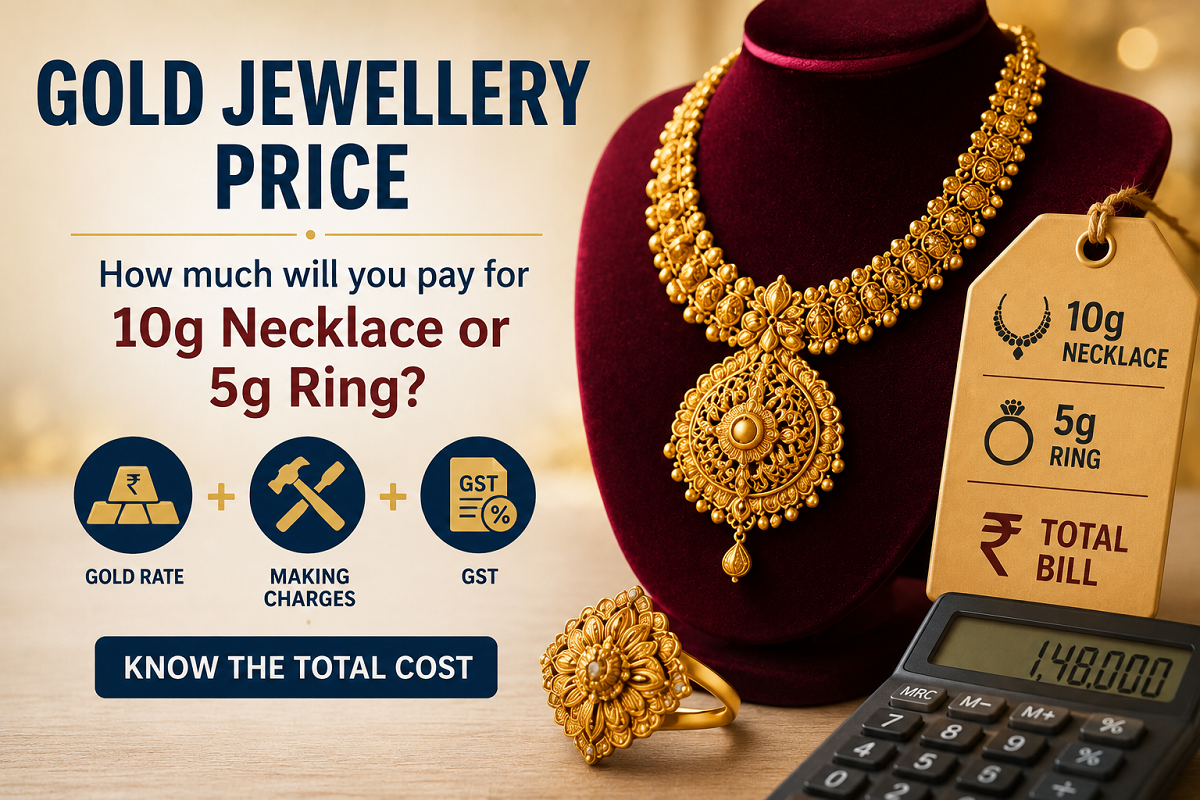
Gold rate is only one part of the final bill, as making charges, GST and possible wastage fees can significantly raise the purchase price
Buying gold jewellery involves much more than checking the daily bullion rate. Customers planning to purchase a necklace, ring, bracelet or any other ornament must also account for making charges, Goods and Services Tax (GST), and, in some cases, wastage or stone-related costs.
This is why jewellery worth around ₹1.31 lakh based purely on its gold content can generate a final bill approaching ₹1.50 lakh or even more. The total amount depends heavily on the design, purity, weight and charges imposed by the jeweller.
Here is an illustrative calculation showing how much a buyer may need to pay for a 10-gram necklace or a 5-gram gold ring based on the quoted Delhi gold prices for July 15, 2026.
Gold Rates Used for the Calculation
The quoted gold prices in Delhi were:
| Gold Purity | Price per 10 Grams |
|---|---|
| 24-carat gold | ₹1,42,940 |
| 22-carat gold | ₹1,31,040 |
| 18-carat gold | ₹1,07,240 |
Most wearable jewellery is commonly made using 22-carat or 18-carat gold, as pure 24-carat gold is softer and generally considered less suitable for intricate ornaments.
The following calculations are based on the quoted 22-carat rate of ₹1,31,040 per 10 grams.
Estimated Bill for a 10-Gram Gold Necklace
Suppose a customer selects a simple 10-gram necklace made of 22-carat gold.
The value of the gold itself would be:
Gold cost: ₹1,31,040
If the jeweller charges a making fee of 10%, the additional amount would be approximately:
Making charge: ₹13,104
The subtotal before tax would therefore be:
₹1,31,040 + ₹13,104 = ₹1,44,144
A 3% GST on this amount would be around:
GST: ₹4,324
The approximate final bill would then be:
₹1,48,468
Therefore, a simple 10-gram necklace could cost close to ₹1.48 lakh, assuming a 10% making charge and no additional wastage or stone cost.
What If the Making Charge Is Higher?
Intricate or handcrafted jewellery often attracts a higher making charge. If the jeweller applies a 20% making fee, the calculation changes significantly.
- Gold value: ₹1,31,040
- Making charge at 20%: ₹26,208
- Subtotal: ₹1,57,248
- GST at 3%: Approximately ₹4,717
- Estimated total: Around ₹1,61,965
This means that a heavily designed 10-gram necklace could cost approximately ₹1.60 lakh to ₹1.62 lakh, depending on the jeweller’s pricing structure.
Estimated Price of a 5-Gram Gold Ring
For a 5-gram ring made of 22-carat gold, the metal value would be half the quoted 10-gram rate.
Gold cost for 5 grams: ₹65,520
At a 10% making charge:
Making charge: ₹6,552
The subtotal would be:
₹65,520 + ₹6,552 = ₹72,072
GST at 3% would be approximately:
₹2,162
The estimated final price would therefore be:
₹74,234
A basic 5-gram gold ring could consequently cost around ₹74,200.
If the ring features detailed craftsmanship, stones or a premium design, the making charge may increase. In such cases, the final cost could rise to approximately ₹78,000 to ₹80,000, or even higher.
Why Jewellery Costs More Than the Displayed Gold Rate
The daily gold price reflects only the market value of the metal. It does not represent the final retail cost of a finished ornament.
A jewellery bill may include:
- Value of the gold according to weight and purity
- Making or labour charges
- GST
- Wastage charges, where applicable
- Cost of stones, diamonds or other materials
- Certification or additional service charges
Making charges vary widely among jewellers. Some calculate them as a percentage of the gold value, while others charge a fixed amount per gram.
Important Questions to Ask Before Buying
Before finalising a jewellery purchase, customers should confirm:
- What percentage or per-gram making charge is being applied?
- Is any wastage fee being added separately?
- On which amount is GST being calculated?
- Does the ornament carry a valid BIS hallmark?
- What is the net gold weight after excluding stones?
- What exchange value will be offered for old jewellery?
- Is the making charge refundable during exchange or resale?
Buyers should also request a detailed invoice showing the purity, gross weight, net gold weight, making charges, taxes and hallmark information separately.
Final Cost May Vary
These calculations are only estimates based on the quoted gold rate and assumed making charges. Actual jewellery prices can vary across cities, retailers and designs.
A plain ornament generally carries lower labour charges, while antique, handcrafted or stone-studded designs may cost considerably more. Buyers should therefore compare the full billing structure rather than choosing a jeweller solely on the advertised gold rate.
Disclaimer: This article is intended for general informational purposes only. Gold rates, taxes and jewellery charges may change, while making and wastage fees differ among sellers. Customers should verify the latest price and billing terms directly with the jeweller before making a purchase.