BUSINESS
Elon Musk's AI Bubble Warning: Could Hundreds of AI Companies Shut Down as Data Centre Costs Soar?
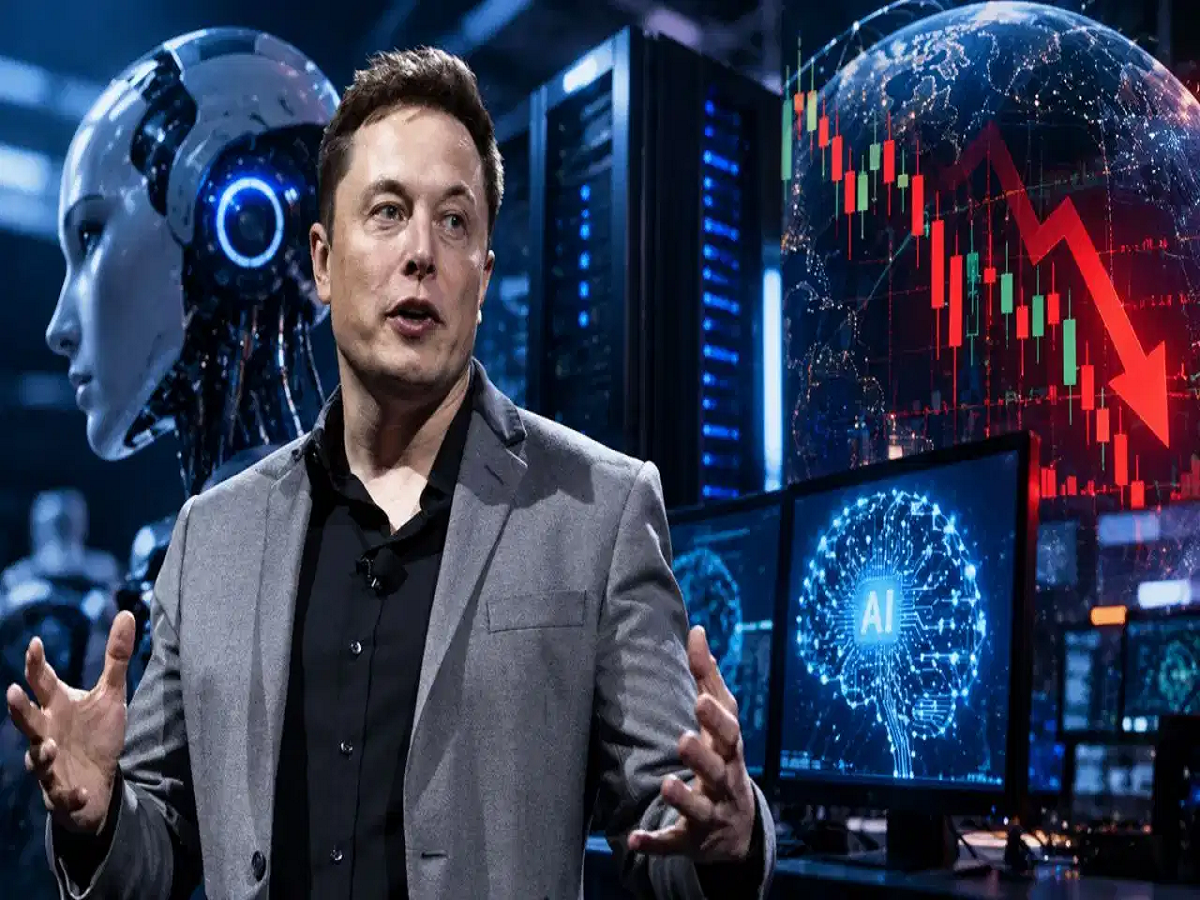
The artificial intelligence industry is experiencing an unprecedented investment boom, with companies spending billions of dollars on advanced chips, cloud computing and data centres. However, growing concerns about debt, rising financing costs and uncertain returns are raising a difficult question: is the AI boom heading towards a major crash?
Tesla and SpaceX chief Elon Musk has reportedly warned that hundreds of specialised AI cloud companies could shut down or merge with larger businesses. His warning has intensified concerns about companies that borrow heavily to build computing infrastructure while depending on future AI demand to recover their investments.
At the same time, Nvidia CEO Jensen Huang has argued that demand for computing power remains exceptionally strong. The disagreement highlights the central issue facing the industry: AI demand may be growing rapidly, but not every company investing in it will necessarily make a profit.
What Are Neocloud Companies, and Why Are They at Risk?
Neocloud companies specialise in providing computing infrastructure for artificial intelligence. They operate or rent data centres equipped with powerful graphics processing units (GPUs), which AI developers use to train models and run AI applications.
Unlike established technology giants, many smaller providers depend heavily on borrowed money to purchase expensive equipment and expand their facilities.
Their business model relies on renting this computing capacity to customers at prices that cover equipment costs, electricity, maintenance, financing and other expenses.
The problem arises when companies invest in infrastructure based on expectations of future demand. If customers do not generate enough revenue to justify their spending, or if financing becomes more expensive, the companies may struggle to repay their debts.
Musk's reported prediction that more than 200 neocloud companies could close or consolidate reflects these concerns. However, it should be treated as a forecast rather than a confirmed outcome.
Why Are Investors Becoming Nervous?
Several factors are putting pressure on AI infrastructure companies.
First, building a data centre requires substantial capital. Companies must purchase GPUs, secure land, install cooling systems and obtain reliable electricity supplies before generating significant revenue.
Second, higher interest rates and borrowing costs can make debt-funded expansion less attractive. A company that appeared financially viable when loans were inexpensive may struggle when refinancing becomes more costly.
Third, investors are becoming more selective about which businesses deserve additional funding. Companies with reliable customers, strong balance sheets and long-term contracts may continue to attract investment, while weaker businesses could face financial difficulties.
Reported declines in some AI infrastructure companies' share prices and bond values have added to market concerns. Nevertheless, falling share prices alone do not prove that a company is heading towards bankruptcy.
Is the AI Bubble Bursting or Simply Losing Air?
Market experts have offered a more measured interpretation of the situation. One possibility is that the industry is undergoing a correction rather than heading towards a complete collapse.
During an investment boom, companies often spend aggressively because they expect future demand to grow rapidly. Eventually, investors begin demanding evidence that this spending will produce sustainable profits.
A correction can remove poorly planned projects, discourage excessive borrowing and redirect funding towards businesses with stronger economics.
For example, a company that builds a data centre without securing sufficient customers may struggle, while a provider with long-term contracts and efficient operations may continue growing.
This distinction is important because the failure of some AI infrastructure businesses would not necessarily mean that artificial intelligence itself is becoming less useful.
Gartner's Infrastructure Spending Forecast Raises Questions
The report cites Gartner estimates suggesting that AI infrastructure investment could reach approximately $1 trillion in 2026, followed by substantial additional spending through 2030.
Such projections highlight the enormous financial commitments being made to support AI development. However, these figures should be interpreted carefully because infrastructure spending, data centre revenue and the economic value generated by AI are different measures.
For an infrastructure investment to be financially sustainable, the revenue generated over its useful life must justify the initial capital expenditure, operating expenses and financing costs.
If demand grows more slowly than expected, or if computing prices decline rapidly, some investments may never deliver their anticipated returns.
Another risk is technological obsolescence. Newer, more efficient chips can reduce the competitiveness of older hardware before investors have fully recovered their costs.
The specific Gartner projections and the claim that more than $3.5 trillion in infrastructure investment could be at risk should be checked against the original research before being treated as definitive forecasts.
Why Microsoft, Amazon and Alphabet Are Better Positioned
Large technology companies generally have an advantage because AI infrastructure is only one part of their broader businesses.
Microsoft, Amazon and Alphabet generate revenue through cloud services, software, advertising and other established operations. These businesses can help finance AI investment even when individual projects take years to become profitable.
They also have the financial resources to negotiate long-term contracts, invest in custom chips and build infrastructure at scale.
Smaller neocloud providers may have fewer ways to absorb losses or refinance debt if customer demand weakens.
However, even the largest technology companies face risks. If AI-related revenue grows more slowly than infrastructure costs, they may reduce spending, delay projects or demand better returns from their investments.
What Could Happen to Nvidia and the Wider Technology Market?
Nvidia supplies GPUs and related technology used in many AI data centres. Its business benefits from demand for computing power, but its customers' financial health also matters.
If neocloud companies face funding difficulties, they may reduce or postpone hardware purchases. That could affect suppliers across the AI ecosystem, including chip manufacturers, server producers and data centre operators.
On the other hand, if established cloud providers continue expanding their AI infrastructure, demand for advanced computing equipment could remain strong even if smaller competitors disappear.
The outcome will therefore depend on how AI demand develops, whether customers can afford the infrastructure and how quickly investments generate returns.
Will Hundreds of AI Companies Really Shut Down?
A wave of closures and mergers is possible if heavily indebted companies cannot secure financing or generate sufficient cash flow. However, it would be premature to conclude that hundreds of companies will definitely fail.
The most important warning signs to watch are rising borrowing costs, weakening customer commitments, declining computing rental prices, lower equipment utilisation and difficulty refinancing debt.
Companies with diversified revenue, manageable debt and long-term contracts are generally better positioned to survive a downturn.
The broader lesson is that a growing technology market does not guarantee that every company operating within it will succeed. AI may continue transforming businesses while some infrastructure providers experience serious financial losses.
The future of the AI industry will depend not only on technological breakthroughs but also on whether companies can turn enormous investments into sustainable revenue and profits.