INTERNATIONAL
America's pride was shattered; a 500 billion dollar naval fortress was demolished by a 73 crore rupee submarine, but how?
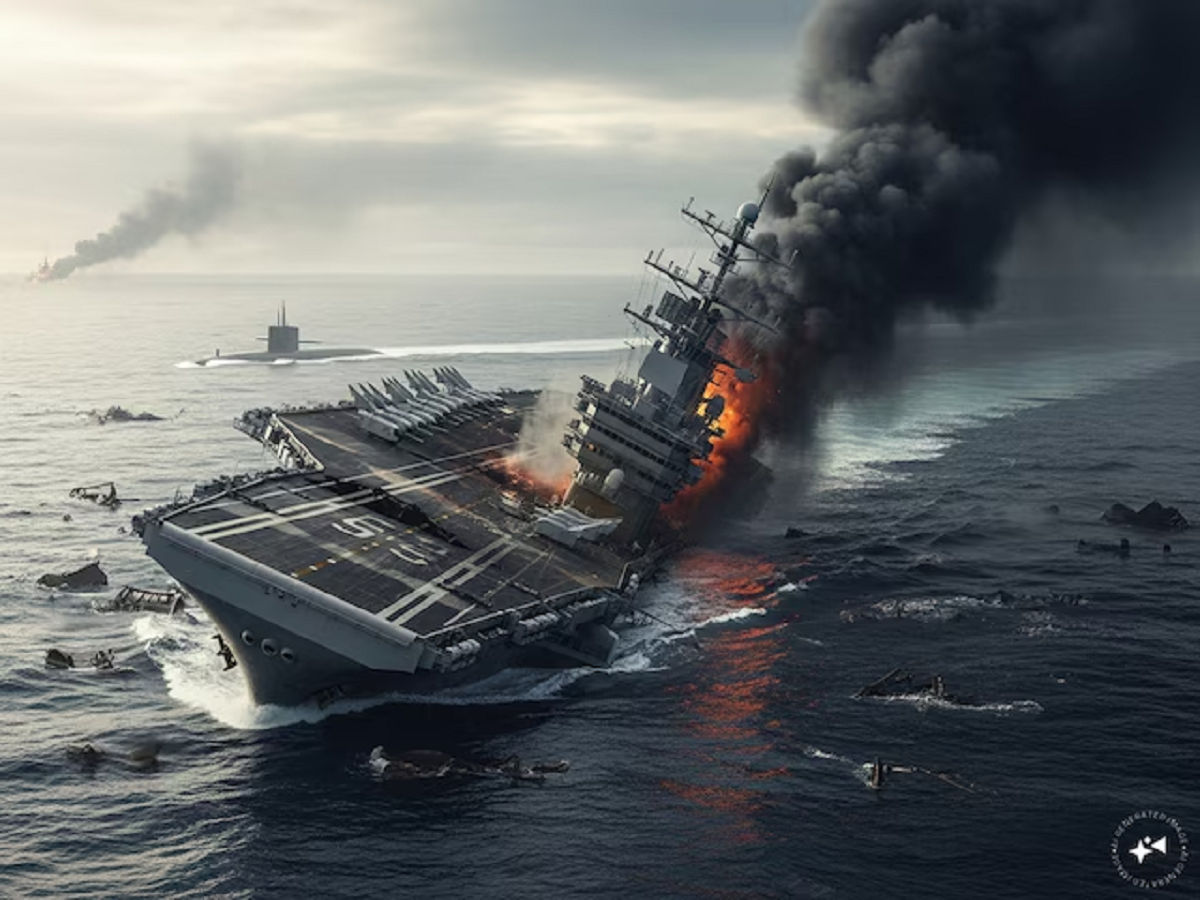
US Aircraft Carrier Sunk by Tiny Submarine: During a NATO naval exercise in the North Atlantic, a Canadian submarine sank a US aircraft carrier. The entire carrier strike group, including the USS Dwight D. Eisenhower, was present for the exercise, escorted by destroyers and surveillance aircraft. The submarine slowly approached the carrier ship and was in a position where it was deemed a success.
US Aircraft Carrier Sunk by Canadian Submarine: The mere mention of American aircraft carriers conjures up images of massive warships. Such magnificent and advanced aircraft carriers, one can only imagine them as impenetrable floating fortresses capable of crushing the enemy's spirits. Imagine a small submarine destroying such a fortress; you wouldn't believe it. However, it did happen, and the submarine of a country whose military is unmatched by the world's number one military almost sank the US aircraft carrier.
This interesting incident occurred during a NATO naval exercise in the North Atlantic, when a Canadian submarine sank an American aircraft carrier. A large carrier strike group of the US Navy was moving through the sea during the exercise. At the center of this fleet was the USS Dwight D. Eisenhower, which is said to be worth approximately $5.5 billion (₹ 505,504,978,000). The enemy of this giant ship was a diesel-powered submarine built for just $80 million.
How did a tiny submarine sink a giant aircraft?
- Such carriers are accompanied by numerous escort ships, helicopters and surveillance aircraft, providing protection against submarines and missiles, but during the exercise, a diesel-electric submarine of the Royal Canadian Navy managed to quietly penetrate this protective ring underwater.
- The USS Dwilight D. Eisenhower is a $5.5 billion (₹ 505,504,978,000) aircraft carrier, the submarine cost about $80 million (₹ 73,49,00,000), much less than the cost of the aircraft carrier.
- The submarine was powered by a diesel-electric system. When operating on battery power, it produced very little noise, making it difficult to detect with sonar. Therefore, it slowly approached the carrier group, remaining hidden by the natural sounds of the ocean.
- In naval exercises, simulations are used instead of real weapons. Once the submarine reaches the distance and angle from which it can launch a torpedo attack, the exercise rules consider it a successful attack.
- The exercise thus resulted in a Canadian submarine sinking the American aircraft carrier USS Dwilight D. Eisenhower.
PC:News18/AI Generated