LIFESTYLE
Zakat Money: Zakat is a charitable act,where does Muslim Zakat money go? Understand the full math

Zakat ka Paisa: In Islam, Zakat is a charitable act, which Muslims pay during the month of Ramadan. Zakat is one of the five pillars of Islam. However, many people are unsure about where Zakat money should and should not be spent. In this article, we will address these important questions.
Where to spend Zakat money: The holy month of Ramadan is going on and Muslims fast for 29-30 days in this month. This month has been given special importance in Islam because in this holy month the verses of Quran were revealed to Prophet Muhammad. This is why the importance of Ramadan increases even more. In the holy month of Ramadan, Muslims fast, worship Allah as much as possible, offer Taraweeh prayers and recite the Quran. Apart from all these, there is one more thing which Muslims pay in this month and that is Zakat. Zakat is one of the five fundamental pillars (Arkan) of Islam.
Just as fasting, prayer, and Hajj are obligatory for Muslims, Zakat is also considered obligatory for every Muslim. No Muslim can opt out of it under any circumstances. There are some important conditions and rules for paying Zakat, which must be followed carefully. Muslims have many questions about Zakat. Often, people pay Zakat but don't know where to spend it. In this article, we will learn from Islamic scholar Mufti Salahuddin Qasmi some important questions related to Zakat and their answers.
What is Zakat?
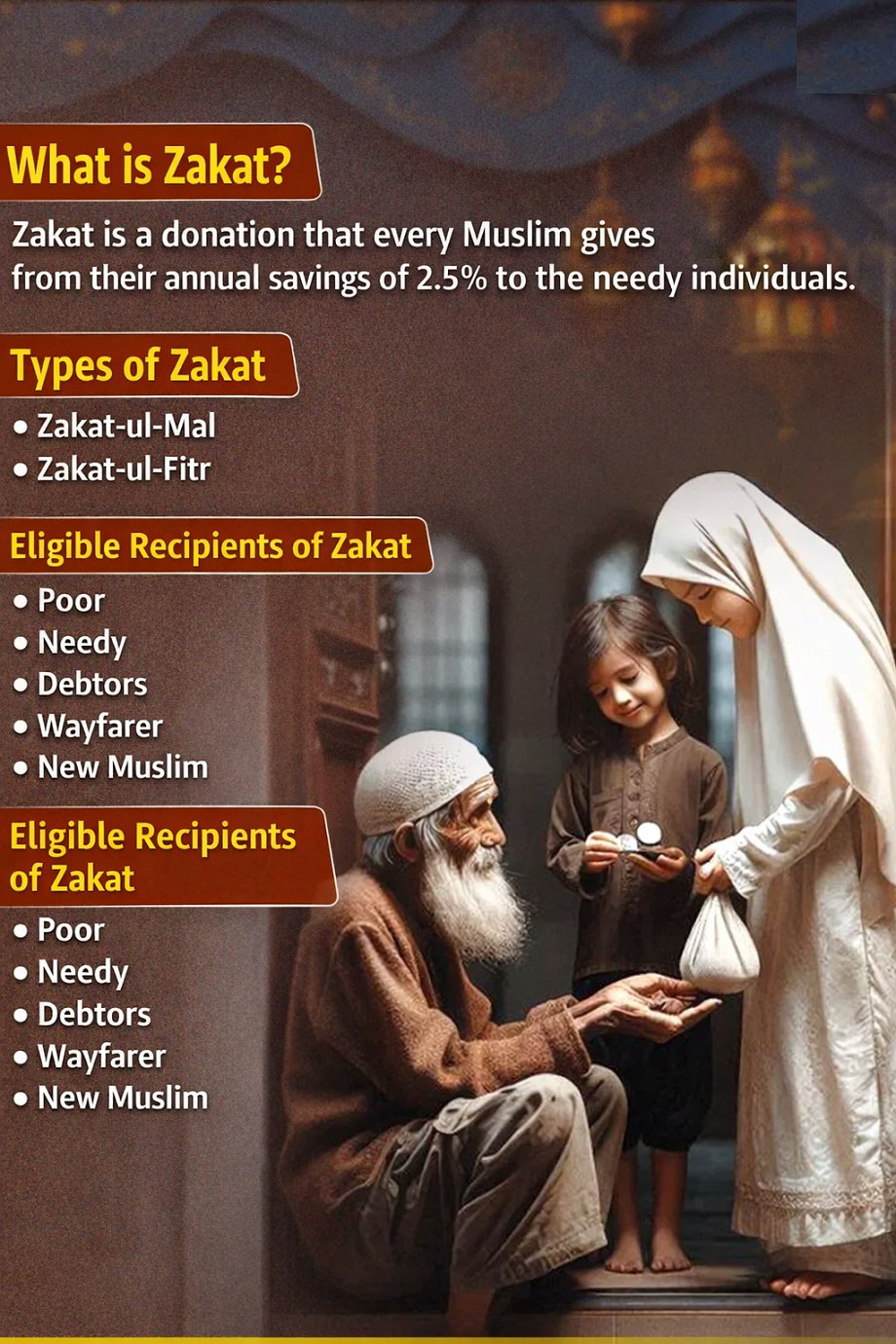
In Urdu, Zakat means to purify, cleanse, and promote progress. In Islam, Zakat is a mandatory donation that every Sahib-e-Nisab Muslim must give two and a half percent (2.5%) of their annual savings to the needy. Now, you might be wondering who a Sahib-e-Nisab is. A Sahib-e-Nisab is a Muslim who, in addition to his basic needs, is free from debt, possesses at least seven and a half (7.5) tolas of gold or fifty-two and a half (52.5) tolas of silver (or the equivalent in cash/trade goods) and has been doing so for a year. Paying Zakat is obligatory for such a person.
When did Zakat become compulsory?
Zakat became obligatory in Medina in the 2nd Hijri (624 CE), after the Hijra. Zakat was decreed approximately 18 months after the Prophet Muhammad (peace be upon him) arrived in Medina in the month of Rajab in the 2nd Hijri, and it was made obligatory shortly before the fasting of Ramadan. This Sahib-e-Nisab is obligatory on Muslims once a year.
How much Zakat should be given?
In Islam, 2.5% (two and a half percent) of eligible assets (possessed for one year and exceeding the Nisab) is obligatory as Zakat, which is one-fourth of one's total wealth. This is required for adults who own at least 87.48 grams of gold or 612.36 grams of silver in an Islamic year.
Who should pay Zakat?
- Zakat can only be given to needy Muslims, not to non-Muslims (they can be given as Sadaqah or charity).
- Zakat cannot be given to close relatives like parents, grandparents, children, grandchildren or spouse.
- If brothers, sisters, uncles, aunts, or other relatives are truly needy (poor), then Zakat can be given to them.
- People from the Sayyid family, who belong to the Hashmi clan (descendants of Prophet Muhammad), are not entitled to receive Zakat.
When is Zakat obligatory?
Zakat is obligatory when a Muslim possesses the Nisab (minimum limit, equivalent to approximately 87.48 grams of gold or 612.36 grams of silver) and the wealth lasts for a full Islamic year (Hajri). The Muslim must be of adulthood and sane, and have no outstanding debts on the wealth. It is only obligatory for wealthy Muslims. It is paid annually, usually during the month of Ramadan.
Conditions for Zakat to be obligatory
- Islam:- The person must be a Muslim.
- Freedom: He should not be a slave (he should be free).
- Adult: Must be an adult, not a duty on minors.
- Wisdom:- One should be sane (mentally healthy), it is not a duty if one is mentally ill.
- Sahib-e-Nisab:- He should have money equal to Nisab (minimum limit).
- Hajri (whole year):- His wealth should remain above the Nisab limit for one year.
When should Zakat be paid?
When your wealth exceeds the Nisab limit for an entire Islamic year, you must pay Zakat at the end of that year. Zakat can be paid in any month, but paying Zakat in the month of Ramadan is considered better and more rewarding. There are two types of Zakat, as described below:
- Zakat-ul-Mal: This is obligatory on wealth subject to the conditions mentioned above.
- Zakat-ul-Fitr (Fitrana): This is obligatory on every Muslim (children, old, rich, poor, everyone) at the end of Ramadan before Eid, whether they have money or not.
Where should Zakat money not be spent?
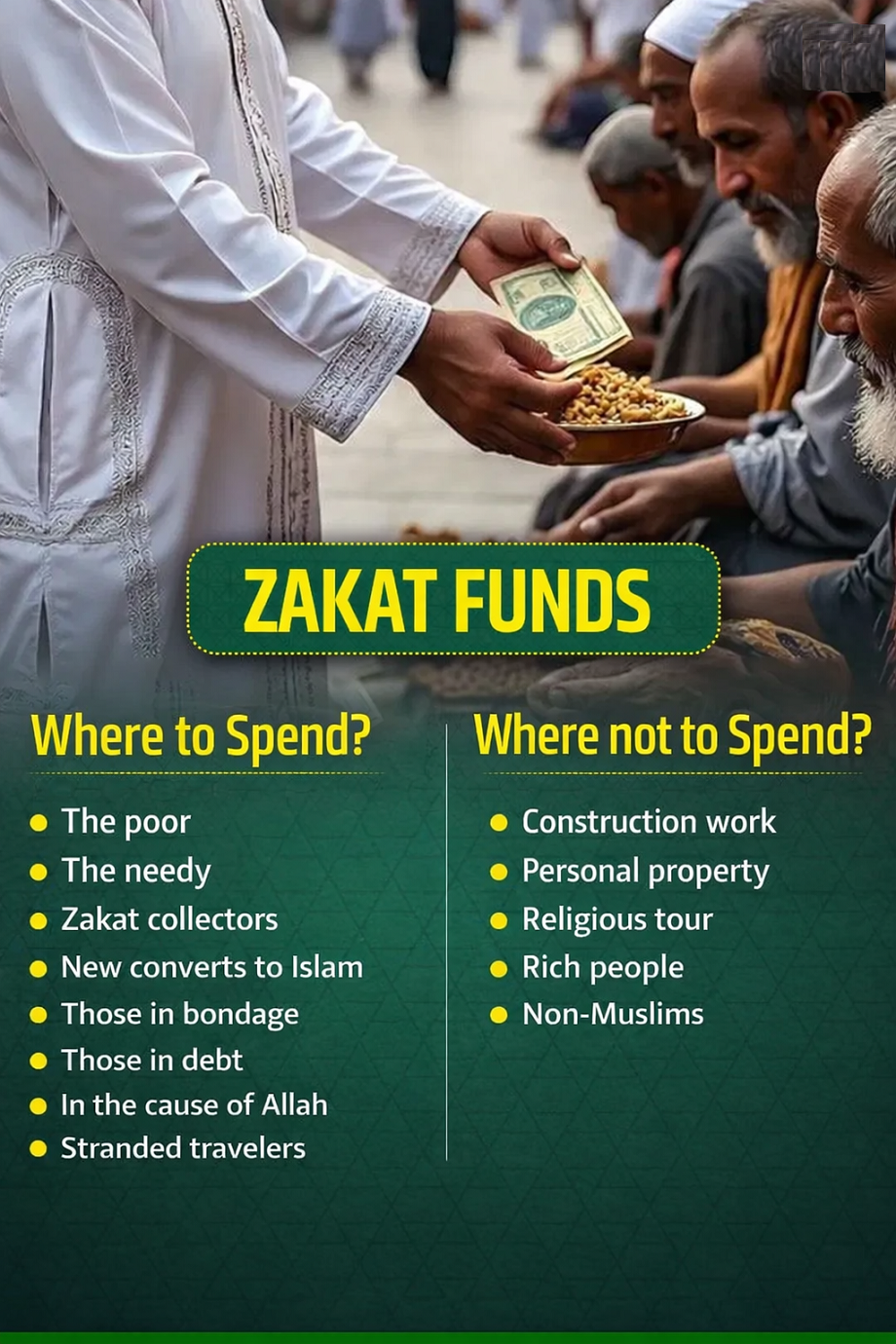
- Construction work: Zakat money cannot be used for building a mosque, madrasa, hospital or library.
- Public works: - Zakat money is not used for roads, bridges, or any public welfare work.
- Rich people: - It is not permissible to give Zakat to those who are wealthy (Sahib-e-Nisab).
- Hajj-Umrah: - Zakat money cannot be used for performing Hajj or Umrah.
- Iftar and Sehri :- It is not permissible to spend Zakat money on public Iftar parties or Sehri.
- Non-Muslims:- Zakat money can be given only to poor Muslims.
- Personal Property: - Zakat money cannot be spent on acquiring property for oneself or a relative.
- Sinful activities: Do not give this money to people who will use it for haram or sinful activities.
Who is entitled to Zakat?
Islam's most sacred text lists eight individuals entitled to zakat. This is mentioned in the Quran (Surah At-Tawbah 9:60).
- The Poor (Al-Fuqara): People who have little or no property, i.e., the extremely poor.
- The needy (Al-Masakin): Those who do not have money to fulfill even their basic needs.
- Debtors (Al-Gharimin): Those who are in debt and are unable to repay it.
- Traveler (Ibn Us Sabil): One who is stranded during a journey and does not have money to return home.
- New Muslims (Mu'allafah Quloobuhum): Those who have recently converted to Islam and need help.
- Slave (Ar Riqab): One who is freed from slavery or bonded labour.
- In the path of Allah (Fi Sabilillah): Those who are engaged in the welfare of society or religious work.
- Amil: People who are engaged in collecting and distributing Zakat.
Important rules of Zakat
- It is better to distribute Zakat among the poor in the same city where you live.
- Zakat money is the right of the poor and do not use it for yourself.
- Can be given to poor relatives (like brother, sister, nephew, niece, uncle) if they are entitled.
- Husband and wife cannot give Zakat to each other.
- You should have complete possession of the property i.e. ownership rights, not anyone else.
- The asset must have potential for growth (such as a business or an animal).
PC:TV9Bharatvarsh