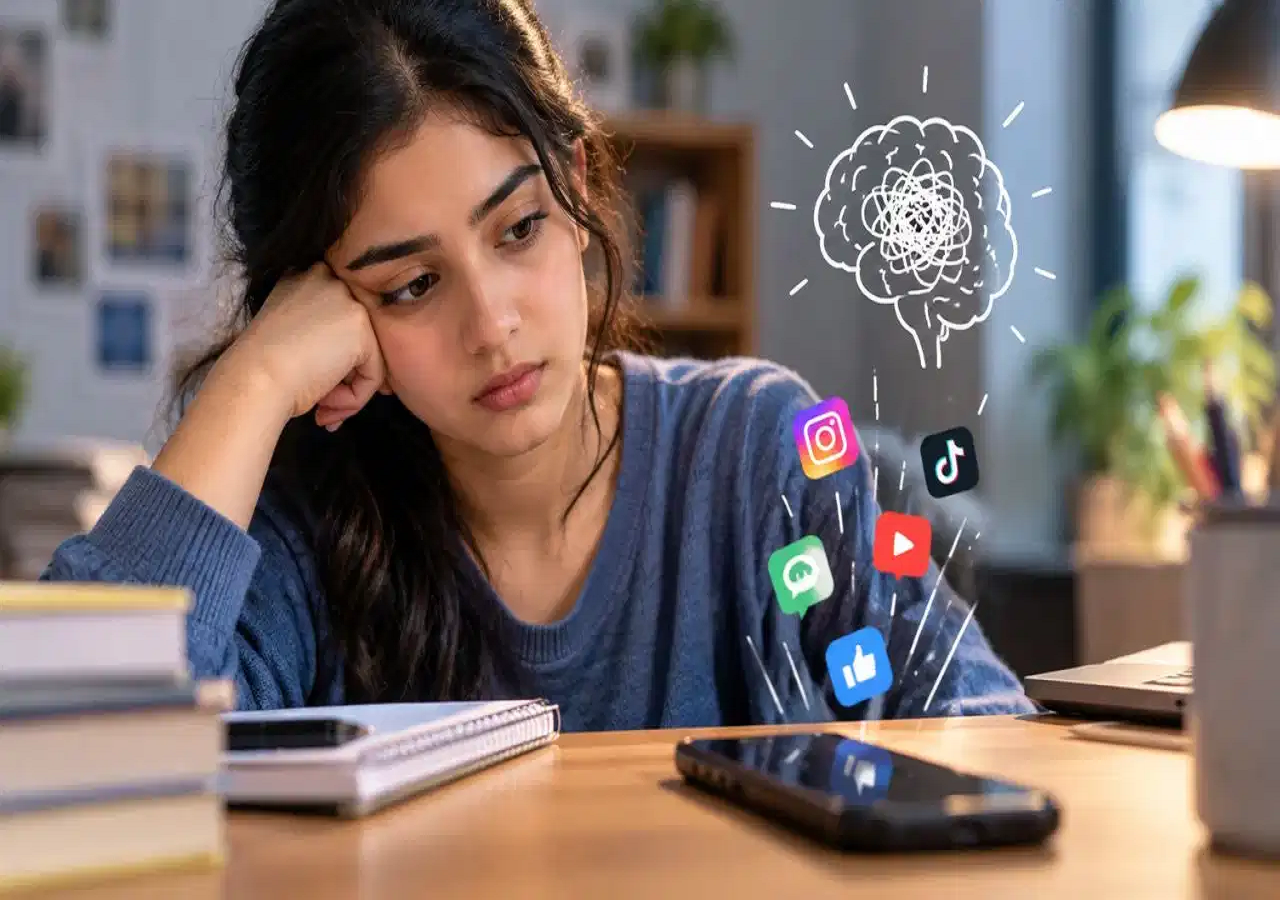
Your smartphone is lying on the table. The screen is off. There are no notifications, calls or messages waiting for you.
So, you might assume your mind is completely focused on the task in front of you.
But what if simply having your phone nearby is enough to affect your concentration?
Smartphones have become much more than devices for making calls. Notifications, endlessly scrolling feeds, app designs and our own habit of checking the screen can constantly pull our attention away. Surprisingly, research suggests that you may not even need to touch your phone for it to compete for your attention.
Your Phone May Be Using Brainpower Without You Realising It
In 2017, Adrian Ward, an assistant professor at the McCombs School of Business at the University of Texas, and his research team conducted an experiment involving nearly 800 smartphone users.
Participants were asked to complete cognitive tests while their phones were placed in different locations. Some kept their phones on the table, others placed them in a pocket or bag, while a third group left their phones in another room.
The results were striking.
Participants whose phones were in another room performed better on the cognitive tests. Researchers referred to this phenomenon as the "brain drain" effect—the idea that the mere presence of a smartphone can consume some of our limited mental resources, even when we are not actively using it.
Research published later has also explored how the visibility and accessibility of smartphones can affect attention and cognitive performance.
Why Does Your Phone Distract You?
There are several reasons your smartphone can become a constant source of distraction.
Notifications
A message notification, social-media alert, email, news update or shopping notification can instantly interrupt whatever you are doing.
Even when the notification isn't important, it can create a strong urge to check what happened.
You may tell yourself, "I'll just look for a second," but that small interruption can make it harder to return to your original task.
Apps Are Designed to Keep You Engaged
Many popular apps are built around features that encourage continuous engagement.
Endless scrolling, autoplay videos, recommendation algorithms, notification badges and automatically loaded content remove the natural stopping point.
You watch one video, and another immediately appears.
You check one post, and there is another waiting.
What begins as a quick check can easily turn into several minutes—or much longer.
Your Brain Can Turn Checking Into a Habit
Perhaps the biggest problem isn't always the notification.
Sometimes, you reach for your phone simply because you are bored, stuck on a difficult task or have a few seconds to spare.
Over time, this behaviour can become automatic.
Waiting for an elevator? Check the phone.
Finished one task? Check the phone.
Feeling bored for a few seconds? Check the phone.
Eventually, reaching for the smartphone can become a habit rather than a conscious decision.
Smartphones Are Everywhere in India
For many Indians, completely disconnecting from smartphones isn't realistic.
Phones are now deeply integrated into everyday life. People use them for work, education, digital payments, shopping, banking, entertainment, communication and navigation.
Government surveys have also highlighted the widespread use of smartphones and mobile phones across Indian households and among younger people.
That makes the question less about whether we should use smartphones and more about how we can use them without allowing them to constantly interrupt our attention.
It's Not Just About Screen Time
When people talk about smartphone addiction or excessive phone use, they often focus on the number of hours spent looking at a screen.
But there is another important factor: how frequently your attention is interrupted.
For example, spending two hours watching a film intentionally is very different from spending two hours repeatedly switching between work, notifications, social media and messages.
Constant interruptions can make it difficult to maintain deep concentration, even if your total screen time doesn't appear unusually high.
How to Take Back Control of Your Attention
You don't have to stop using your smartphone to improve your concentration.
Instead, try reducing the triggers that make you check it unnecessarily.
Turn Off Unnecessary Notifications
Keep notifications only for apps and people that genuinely require your immediate attention.
Most social-media, shopping and promotional alerts can wait.
Keep Your Phone Out of Reach
When studying, working or doing something that requires concentration, don't simply put your phone on silent and leave it next to your laptop.
Put it in a drawer, bag or another room if possible.
The extra physical distance can make it less tempting to check.
Remove Distracting Apps From Your Home Screen
You don't necessarily have to delete social-media apps.
Simply making them less visible can reduce the number of times you open them automatically.
Disable Autoplay
Turning off autoplay on video and social-media platforms can create a natural stopping point and prevent one piece of content from automatically leading to another.
Create Specific Phone-Checking Times
Instead of checking your phone every few minutes, decide when you will check messages, social media and other non-essential apps.
This can help turn phone use from an automatic reaction into a deliberate choice.
The Real Problem May Be the Constant Interruption
Smartphones aren't inherently bad. They can make our lives easier, keep us connected and give us instant access to information.
The problem begins when the device starts competing with every other activity for our attention.
Sometimes, the most effective way to improve your focus isn't to activate another productivity app or find a complicated technique.
It may simply be to put your phone somewhere you can't see or easily reach it.
So, Who Is Really in Control?
The next time you sit down to study, work or complete an important task, look at where your phone is.
If it's sitting right beside you—even with the screen turned off—try putting it somewhere else for a while.
You might discover that the biggest distraction in the room wasn't the notification you received.
It was the possibility of receiving one.
Smartphones are becoming more powerful every year. But the more connected we become, the more important it may be to protect something technology can't give us back: our attention.