Your Phone Could Soon Know What You Need Before You Ask: How AI Agents Are Changing Smartphones
- byPranay Jain
- 31 Aug, 2026
Smartphones are slowly moving beyond being devices that simply respond to commands. The next major shift in technology is AI agents—software that can understand what you want, make decisions and complete multiple steps on your behalf.
Recent developments in AI and smartphones show that companies are increasingly integrating these assistants directly into everyday device functions. Google's latest Pixel phones, for example, have placed greater emphasis on AI features designed to help users complete tasks with fewer taps and swipes.
What Makes an AI Agent Different?
Traditional voice assistants usually wait for a specific command.
For example, you might say, "Set an alarm for 7 AM," and the assistant performs that single task.
An AI agent is designed to handle a series of actions. Instead of simply answering a question, it could potentially understand a broader request, decide what needs to be done and complete several connected steps.
This is why AI agents are being described as the next stage of personal computing.
Your Phone Could Become More Proactive
Imagine telling your phone, "I'm travelling tomorrow, help me get everything ready."
An advanced AI system could potentially look at your calendar, identify the travel plans, check relevant information and prepare reminders or suggestions.
The important difference is that the user wouldn't necessarily have to open several apps and perform each task manually.
The technology is moving towards this kind of interaction, with AI increasingly being integrated directly into operating systems and apps.
AI Is Already Moving Deeper Into Android
Google has been expanding Gemini's role across Android. A recent update reportedly adds an "Ask Gemini" shortcut directly to the text-selection menu, allowing users to send highlighted text to Gemini without going through the traditional sharing process.
This may seem like a small change, but it demonstrates a larger trend: AI is gradually becoming part of the operating system rather than remaining a separate app.
In the future, users may not even need to think about which AI application they should open.
The Biggest Challenge Is Privacy
More powerful AI assistants also mean that phones could potentially need access to more information.
For an AI agent to provide highly personalised assistance, it may need to understand things such as your messages, calendar, location, files or app activity.
That creates an important question: how much information should an AI be allowed to access?
Apple, for example, says its newer Apple Intelligence architecture is designed with privacy protections and integrates AI capabilities across devices including iPhone, iPad, Mac, Apple Watch and AirPods.
AI Could Also Change Cybersecurity
The same technology that makes AI agents useful can create new security challenges.
Recent warnings from technology companies and financial authorities have highlighted concerns that increasingly capable AI systems could help attackers discover and exploit vulnerabilities faster. More than 100 technology and financial companies recently called for stronger defences against AI-driven cyberattacks.
This means future smartphones may need smarter security systems alongside smarter AI assistants.
What Could Smartphones Look Like in the Future?
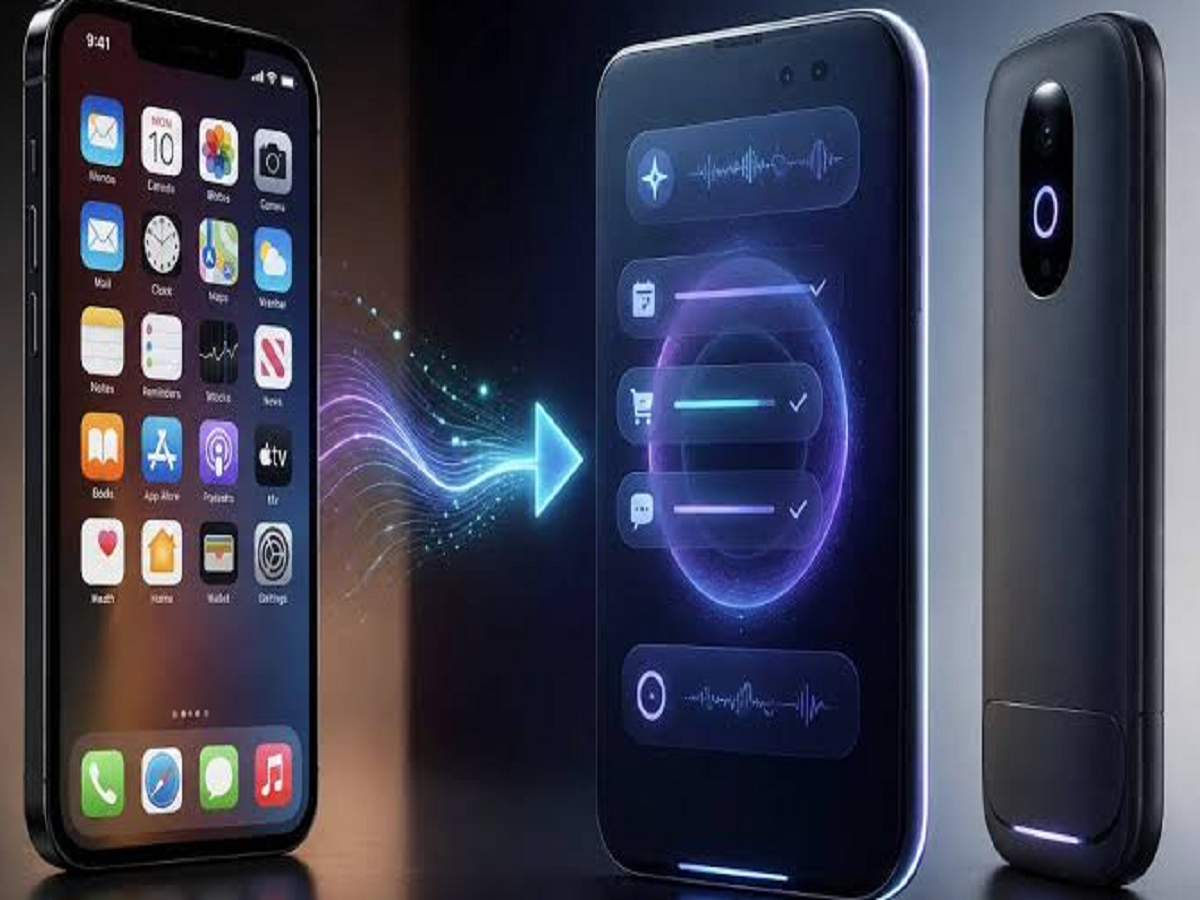
The smartphone of the future may be less about opening individual apps and more about simply telling the device what outcome you want.
Instead of searching for information yourself, you could ask the phone to find it. Instead of manually moving between applications, an AI agent could potentially coordinate the process.
The biggest change, therefore, may not be a faster processor or a better camera. It could be the shift from a phone that waits for instructions to a device that understands context and helps complete tasks.
AI agents are still developing, and many of their most ambitious capabilities are not yet available everywhere. But the direction is becoming clear: the next generation of smartphones could make interacting with technology feel less like operating a machine—and more like delegating work to a digital assistant.
households.
Why Has the Government Introduced This Scheme?
India already has around 1.74 crore domestic PNG connections, but not every installed connection is necessarily being used actively.
Under the new scheme, City Gas Distribution (CGD) companies will receive incentives to convert inactive or unbilled connections into working gas connections and expand PNG networks into additional areas.
This means the focus is not simply on installing more pipelines. The government also wants existing connections to become functional so that more households can actually use piped gas.
What Is PNG and How Is It Different From LPG?
PNG, or Piped Natural Gas, is supplied directly to a home through an underground pipeline network.
Unlike LPG, which is delivered in cylinders, PNG does not require households to order and store individual cylinders.
For households with a functioning PNG connection, cooking gas is supplied continuously through the pipeline system, subject to availability and the local distribution network.
What Could Change for Consumers?
The biggest potential benefit is convenience.
With PNG, households do not need to worry about physically lifting or storing LPG cylinders. There is also no need to wait for a cylinder delivery every time the existing cylinder is nearly empty.
The government describes PNG as a safer, cleaner and more convenient alternative to LPG cylinders and traditional cooking fuels.
Will Everyone Get a PNG Connection?
No. The scheme does not mean that every household in India will automatically receive a PNG connection.
PNG availability depends largely on whether a City Gas Distribution network has been developed in a particular area.
The new incentive scheme is intended to encourage companies to expand their networks and activate more connections, so availability is expected to improve gradually in eligible areas.
What About Households That Already Have a Connection?
If your home already has a PNG connection but it has not become operational or is not being billed because gas supply has not started, the new scheme could be particularly relevant.
One of the government's stated objectives is to encourage CGD companies to convert such inactive connections into active gas connections.
Consumers should therefore check with their local gas distribution company if a connection has been installed but remains unused.
Could PNG Reduce Cooking Costs?
It is difficult to say that PNG will automatically be cheaper than LPG for every household.
The actual cost depends on the local PNG tariff, consumption, taxes, fixed charges and other applicable fees. LPG prices and subsidies can also vary.
Therefore, households should compare the complete monthly cost rather than assuming that switching to PNG will always result in immediate savings.
A Major Shift in Household Cooking Fuel
The government's latest initiative is part of a larger effort to expand India's city gas distribution network.
If more areas receive functioning PNG networks, households could gradually have another option besides LPG cylinders and traditional cooking fuels.
For consumers, the key point is simple: if PNG is available in your area, the coming expansion could make getting an active household connection easier. The scheme takes effect from September 1, 2026, so the impact of the new incentives should become clearer as gas distribution companies expand and activate more connections.