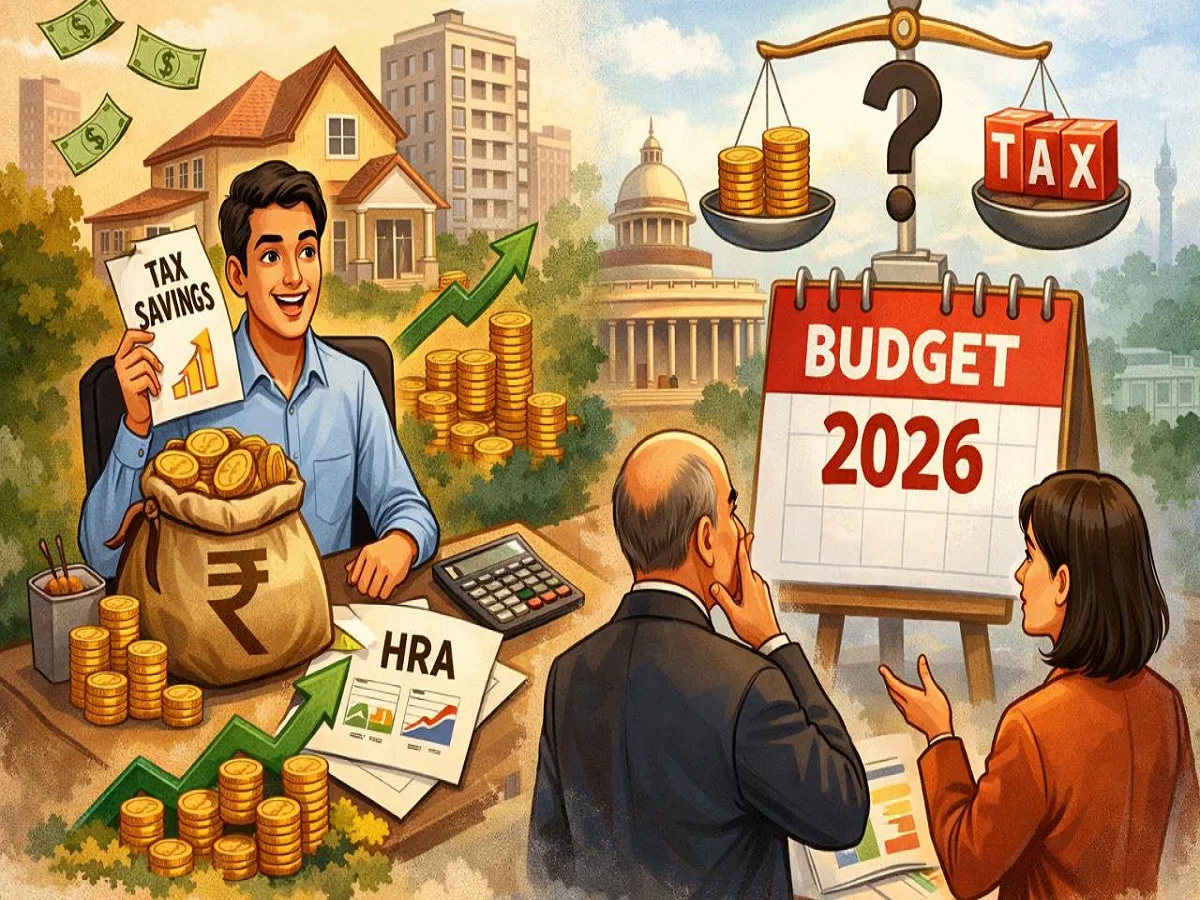
For salaried individuals, House Rent Allowance (HRA) remains one of the strongest tax-saving tools—often saving lakhs in income tax. Unlike other exemptions, there’s no fixed upper limit, though the tax exemption is calculated using a set formula:
-
Actual HRA received from the employer
-
Rent paid minus 10% of salary (basic + DA + commission)
-
50% of salary for metro cities, 40% for non-metro cities
The lowest of these three determines the tax-free amount.
Old vs New Tax Regime
-
The old tax regime allows HRA exemptions, often making it more beneficial for salaried employees in metros with high rent.
-
The new tax regime is simpler but does not offer HRA benefits, so employees in high-rent cities may end up paying more tax if they switch.
Example:
-
Annual salary ₹30 lakh, living in Mumbai, paying high rent → HRA exemption can save lakhs in tax under the old regime.
Budget 2026 Expectations
Experts suggest key changes could make HRA more aligned with modern realities:
-
Metro classification update: Cities like Bengaluru, Hyderabad, Pune, Gurugram, and Noida should be reclassified as metro cities so residents can avail up to 50% HRA exemption.
-
Index-linked HRA: Linking HRA limits to a housing price index (like CPI-Housing or NHB RESIDEX) would automatically adjust HRA according to rent inflation.
-
Clarity on family rent: Paying rent to parents is allowed, but the transaction must be genuine—bank payments, a written rent agreement, and landlord disclosure in tax returns. Paying rent to a spouse requires extra caution.
Why This Matters
If HRA rules are updated in Budget 2026, millions of salaried taxpayers—especially in high-rent cities—could see significant tax relief, making the old tax regime even more attractive.