Imagine a planet where diamonds fall from the sky instead of raindrops. There are no clouds carrying ordinary water droplets, no umbrellas to protect you and no familiar weather patterns. Instead, scientists believe that deep inside certain distant planets, extreme pressure and temperature may create conditions where diamonds form and move towards the planetary interior.
This extraordinary possibility is associated with two ice giants in our Solar System: Neptune and Uranus.
What Is Diamond Rain?
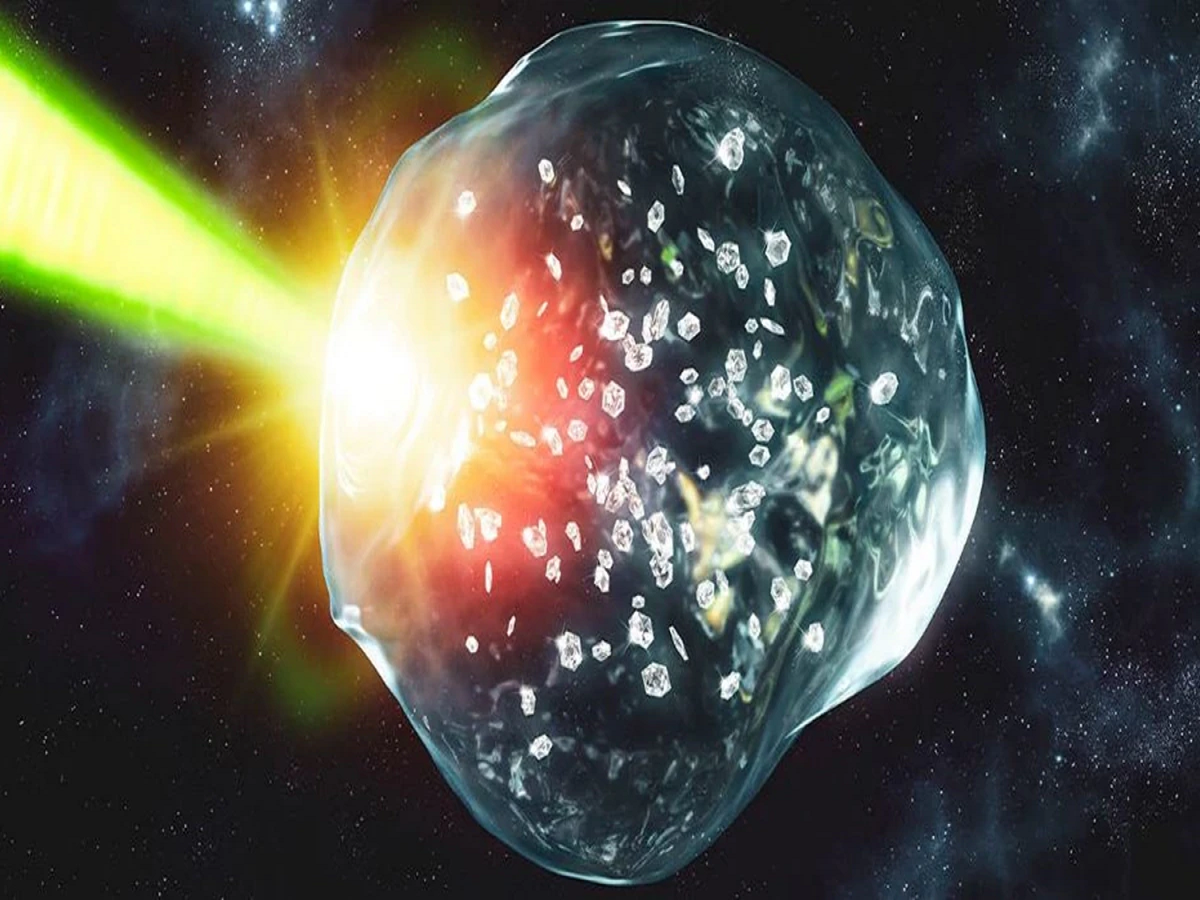
Diamond rain is a scientific theory suggesting that diamonds may form deep inside Neptune and Uranus under extremely high pressure and temperature.
These planets contain materials such as hydrogen, helium, water, ammonia and methane. Methane contains carbon, one of the essential elements required to form diamonds.
Scientists believe that under extreme conditions, carbon-containing compounds may break apart, allowing carbon atoms to combine into diamond structures.
These diamonds could then move deeper into the planets because of their density.
How Can Diamonds Form Without a Diamond Mine?
On Earth, natural diamonds generally form deep underground under enormous pressure and high temperatures over long periods.
However, conditions inside Neptune and Uranus are very different.
Scientists believe the process may involve several stages:
-
Methane and other carbon-containing materials are exposed to extreme pressure and temperature.
-
Chemical bonds break apart, separating carbon from hydrogen.
-
Carbon atoms form structures that can develop into diamonds.
-
The resulting diamond particles move towards deeper layers of the planet.
This process is very different from diamond formation on Earth and remains an active area of scientific research.
Have Scientists Actually Seen Diamond Rain?
Scientists have not directly observed diamond rain inside Neptune or Uranus.
However, laboratory experiments have provided important evidence supporting the possibility.
Researchers have used powerful lasers to recreate some of the extreme pressure and temperature conditions believed to exist inside ice giants.
In these experiments, scientists have observed the formation of tiny diamond structures from carbon-rich materials.
These findings suggest that diamond formation may be possible inside such planets, although the exact process occurring deep within them remains difficult to confirm.
Why Are Neptune and Uranus So Special?
Neptune and Uranus are classified as ice giants because their interiors contain substantial amounts of materials such as water, ammonia and methane.
Unlike Jupiter and Saturn, which are gas giants, these planets have different internal structures and compositions.
Their extreme atmospheric and internal conditions make them particularly interesting subjects for planetary scientists.
Neptune is also famous for its incredibly fast winds, while Uranus has an unusual sideways rotation that makes its seasons especially strange.
Could These Diamonds Ever Reach Earth?
Unfortunately, these diamonds are not waiting to be collected by future space explorers.
They are believed to form deep inside the planets, far below their visible cloud layers. The extreme pressure, temperature and distance make direct exploration extraordinarily difficult.
Even if large quantities of diamonds exist inside these planets, bringing them to Earth would be far beyond current space technology.
What Does This Discovery Teach Us?
Research into diamond rain is important for more than its fascinating name.
It helps scientists understand the chemical composition, internal structure and evolution of distant planets.
Studying how carbon behaves under extreme conditions may also provide useful information about materials science and planetary physics.
Conclusion
A planet where diamonds may form and fall through its interior sounds like something from a fantasy novel. Yet laboratory experiments and planetary research suggest that this unusual phenomenon could be possible inside Neptune and Uranus.
Although scientists have not directly witnessed diamond rain, the theory offers a fascinating glimpse into the extraordinary weather and chemistry of worlds far beyond Earth.
Perhaps the universe is even stranger than we imagine, with natural phenomena that would seem impossible on our own planet.