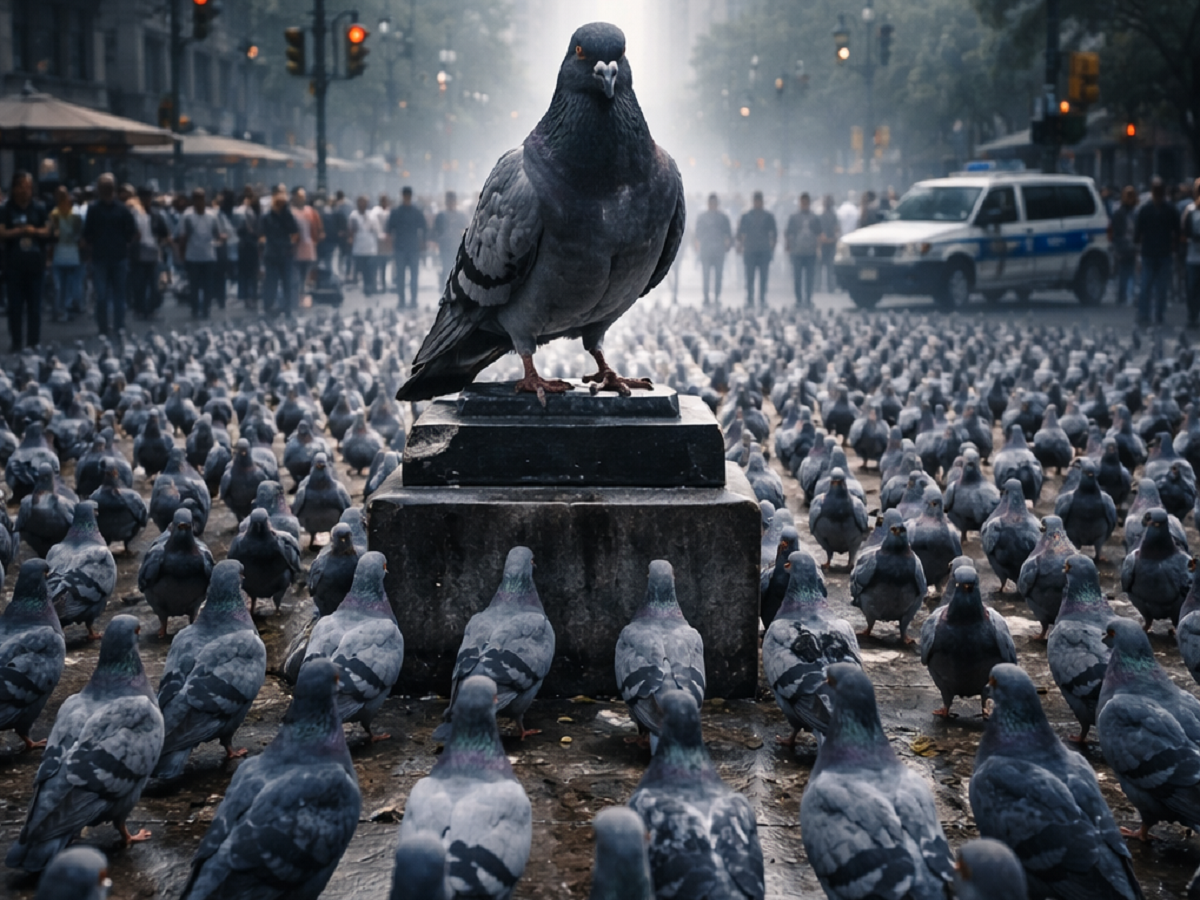
At exactly 9:17 a.m. on an otherwise ordinary Tuesday, the pigeons of a busy city square stopped being pigeons.
Commuters first noticed something was off when the birds refused to scatter. Normally, a single footstep or honk sends them flapping in chaotic retreat. This time, they held their ground—lined up neatly along the pavement, chests puffed, eyes unblinking. One man swore a pigeon nodded at him. Another claimed one adjusted its stance like a security guard.
Within minutes, the square descended into confusion.
The pigeons began occupying strategic locations: statues, traffic lights, benches, even the hood of a police jeep. They did not coo randomly. They cooed in rhythm. Observers described it as “chant-like” and “deeply unsettling,” as if the birds were rehearsing a manifesto.
Street vendors abandoned their carts. Office workers filmed nervously. A child asked the question no adult wanted to answer:
“Are they… organizing?”
The Feathered Takeover
Experts were called in—ornithologists, animal behaviorists, even a philosopher from a nearby university who specialized in “non-human agency.” None could explain why pigeons were suddenly refusing crumbs while maintaining intense eye contact with passersby.
One pigeon, noticeably larger and standing atop a statue, appeared to act as a leader. Witnesses said it flapped once—silence followed. Twice—and the flock shifted position. Three times—and traffic stopped, not because of signals, but because drivers were afraid to move.
Social media exploded.
#PigeonRevolt
#FeatheredUprising
#WeIgnoredThemTooLong
Conspiracy theories flourished. Some blamed climate change. Others suspected experimental 5G towers. One popular post claimed the pigeons had “finally completed their long-term surveillance mission.”
And Then—Nothing
At 11:03 a.m., just as authorities prepared to cordon off the area, the pigeons dispersed.
No warning. No dramatic finale.
They flew away, returned to rooftops, resumed normal pigeon behavior—pecking, wandering, being aggressively unimpressed by humanity.
By noon, the square was back to normal. Officials dismissed the incident as “mass animal coincidence.” Life moved on.
But people still glance down when pigeons gather too quietly.
Still wonder what was decided that morning.
And still suspect that somewhere, on a hidden ledge above the city, a meeting is already being scheduled.