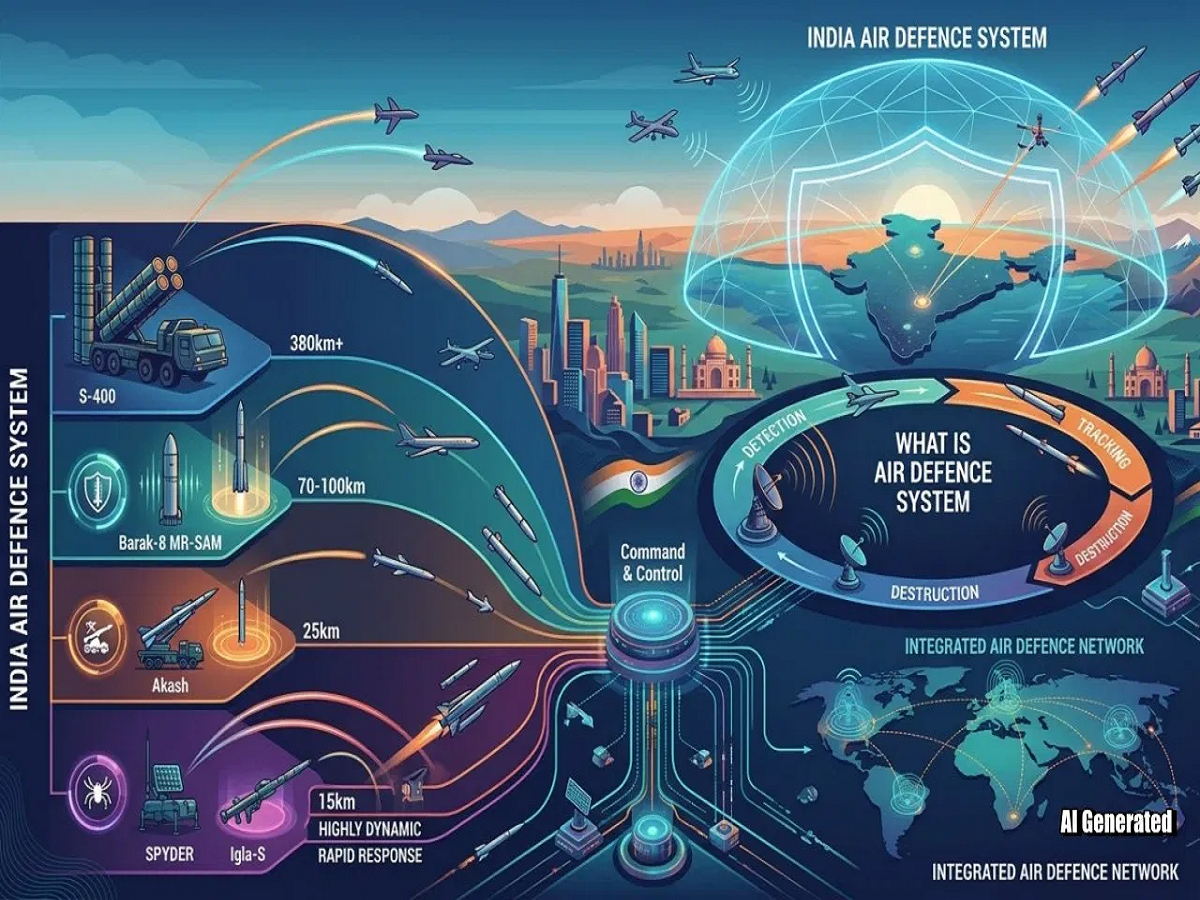
Amid growing global conflicts and rising reliance on advanced military technology, air defence systems have become a critical measure of a nation’s strength. India, too, has developed a robust and multi-layered air defence network designed to counter modern aerial threats with speed and precision.
What is an Air Defence System?
An air defence system is a combination of advanced technologies used to detect, track, and destroy airborne threats such as drones, fighter aircraft, cruise missiles, and ballistic missiles. These systems rely on integrated radar networks and sensors that provide real-time monitoring and rapid response capabilities.
India’s Multi-Layered Defence Network
India’s air defence architecture is built as a layered system, ensuring protection at different ranges and altitudes. It is supported by integrated command and control structures like the Air Defence Ground Environment System and Base Air Defence Zones, which coordinate radar coverage and missile deployment across vast areas.
S-400 Triumf: The Backbone of Long-Range Defence
One of the most advanced components of India’s arsenal is the Russian-origin S-400 system. With a range of up to 380–400 km, it can detect and engage multiple targets, including aircraft, drones, and ballistic missiles. The system is capable of tracking dozens of threats simultaneously and is considered among the most powerful air defence platforms in the world. Its induction has significantly strengthened India’s strategic defence capabilities.
Barak-8 (MR-SAM): Medium-Range Protection
Developed jointly by India’s DRDO and Israel Aerospace Industries, the Barak-8 system offers protection against a wide range of threats, including missiles, aircraft, and drones. With a range of 70–100 km, it is deployed across the Army, Navy, and Air Force, providing versatile mid-range defence.
Akash Missile System: Indigenous Strength
The Akash system is a domestically developed surface-to-air missile system with a range of around 25 km. Known for its high accuracy and 360-degree coverage, it can engage multiple targets simultaneously. It plays a crucial role in defending against fighter jets, cruise missiles, and unmanned aerial vehicles.
Short-Range Systems: SPYDER and Igla-S
For close-range defence, India uses systems like SPYDER and Igla-S. The SPYDER system, sourced from Israel, offers rapid-response capability with a range of up to 15 km. Meanwhile, the Igla-S is a man-portable missile system effective against low-flying aircraft and helicopters within a range of about 6 km.
A Comprehensive Defensive Shield
Together, these systems form a comprehensive and highly coordinated air defence shield. By combining long-range, medium-range, and short-range capabilities, India ensures layered protection against diverse aerial threats.