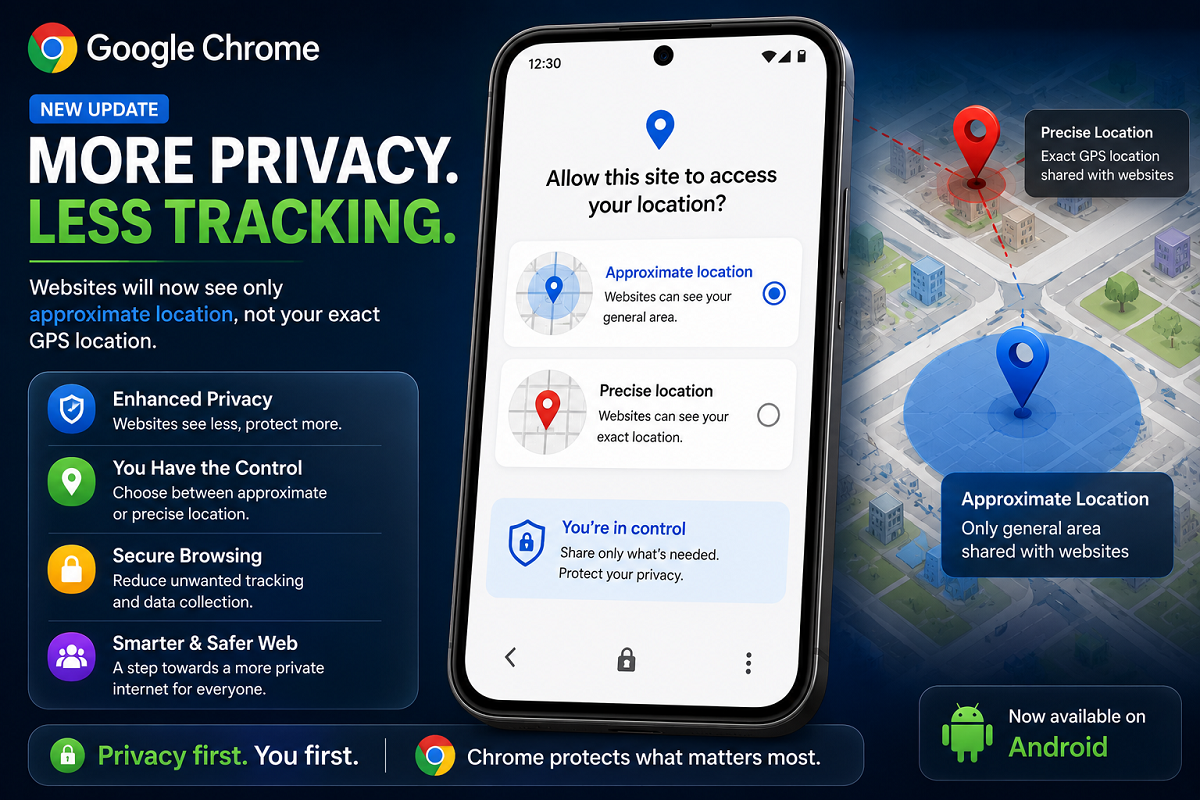
Popular web browser Google has introduced a major privacy-focused update for Android users. With the latest version of Google Chrome, users will now be able to share only an approximate location with websites instead of revealing their exact GPS coordinates.
The new feature is designed to give users greater control over their personal information while browsing the internet. Instead of exposing a highly accurate location, websites will only be able to view a general nearby area unless users specifically choose to share precise details.
Google says the update is aimed at improving online privacy and reducing unnecessary access to sensitive location data.
What Is Chrome’s New Approximate Location Feature?
Until now, when a website requested location access through Chrome on Android devices, users often ended up sharing their exact GPS location.
With the new update, Chrome users can decide whether they want to provide:
- Precise Location
or - Approximate Location
If the approximate option is selected, websites will only receive a broader area estimate instead of the user’s exact position.
For example, instead of identifying a specific building or street address, a website may only know the general neighborhood or surrounding region.
This gives users more privacy while still allowing websites to deliver location-based services.
Why Google Introduced This Privacy Feature
Google says many websites request more location data than they actually need.
In many cases, services such as:
- Local news
- Weather updates
- Regional recommendations
- Nearby general information
do not require exact GPS-level precision.
The company believes users should not have to reveal their precise location every time they visit a website.
By introducing approximate location sharing, Google aims to reduce unnecessary data collection and improve user safety online.
The feature also reflects growing global concerns about digital privacy and tracking practices used by websites and online platforms.
Exact Location Will Still Be Available When Needed
Google has clarified that users will still have the option to share their precise location whenever necessary.
Certain services rely heavily on accurate GPS information, including:
- Navigation apps
- Food delivery platforms
- Ride-booking services
- ATM and office locators
- Real-time maps
For such situations, Chrome will continue offering the precise location option.
This flexible approach allows users to choose the level of information they are comfortable sharing depending on the type of website or service being used.
How the Feature Works on Android
The new privacy feature is currently rolling out for Android users using the Chrome browser.
When a website asks for location access, users will now see additional permission choices related to location precision.
Instead of automatically granting exact access, users can manually decide whether they want to provide:
- Full precise location
or - A less accurate nearby location
This system works similarly to privacy controls already available in recent Android operating system versions.
Google says the goal is to make privacy settings easier to understand and more user-friendly.
Google Also Preparing Changes for Developers
Alongside the user-facing update, Google is reportedly working on new APIs for web developers.
These tools will help websites identify whether approximate location data is sufficient for their functionality or whether exact GPS access is genuinely required.
Google has encouraged developers to request precise location access only in situations where it is truly necessary.
The company believes this could create a healthier and more trustworthy web ecosystem where user privacy is treated more responsibly.
Desktop Chrome Could Get the Feature Soon
Currently, the approximate location feature is rolling out on Android devices, but Google has confirmed plans to expand it further.
According to the company, the same privacy controls are expected to arrive on desktop versions of Chrome in the coming months.
However, an official launch date for desktop users has not yet been announced.
If widely adopted, the update could become one of Chrome’s most important privacy improvements in recent years.
Experts Say Privacy Features Are Becoming Essential
Cybersecurity experts have welcomed the move, saying users are becoming increasingly aware of how their personal data is collected and used online.
Location information is considered highly sensitive because it can reveal:
- Daily routines
- Home and office locations
- Travel patterns
- Personal habits
By limiting unnecessary access to exact coordinates, Chrome’s new feature could help reduce privacy risks and strengthen user trust.
Experts also believe other browsers and tech companies may soon introduce similar protections as competition around digital privacy continues to grow.
With this update, Google is taking another step toward giving users more control over their online identity and personal data while browsing the web.