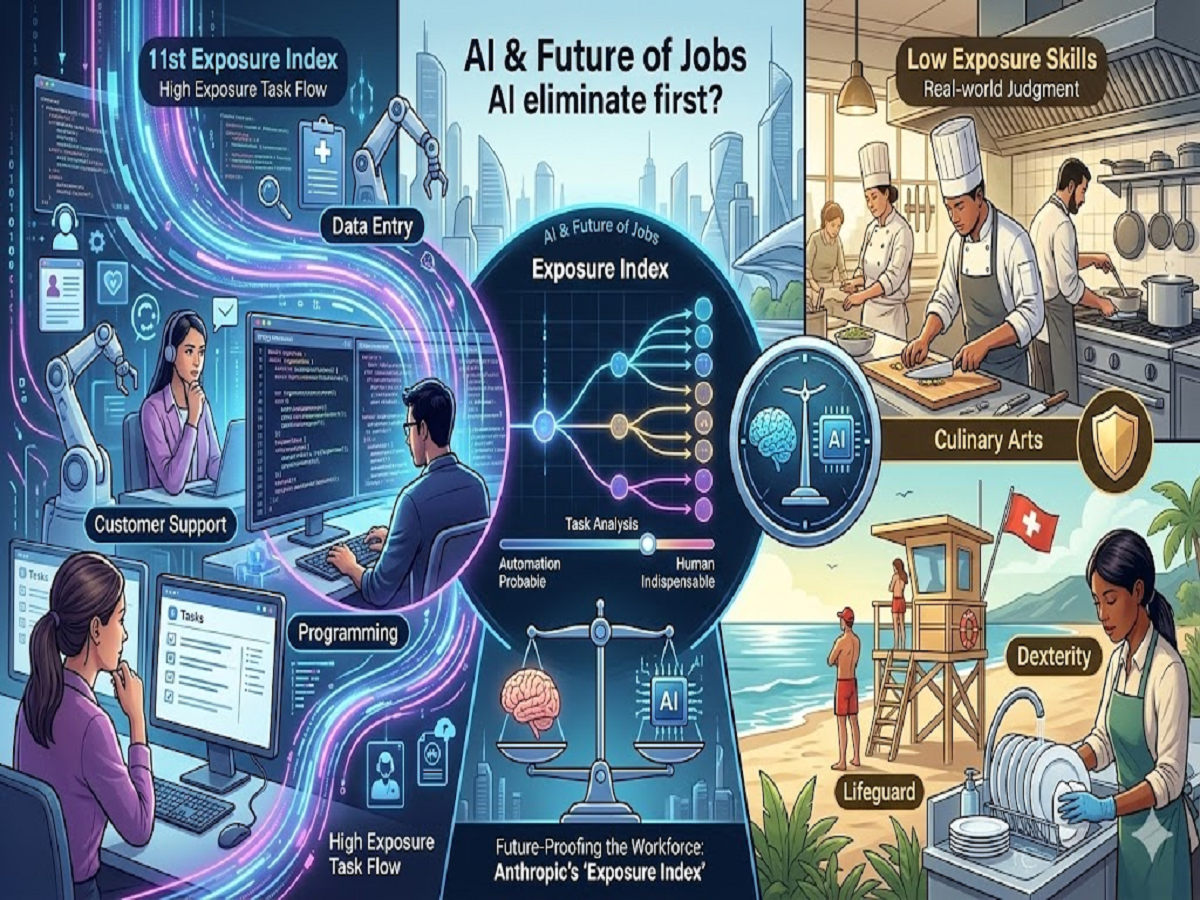
Artificial intelligence is no longer a distant possibility—it is a present force reshaping the global economy. While experts have long debated which sectors will fall first, a new report from Anthropic provides a data-driven roadmap. By shifting the focus from "job titles" to "specific tasks," researchers have identified exactly where the AI wave is likely to hit hardest.
The Exposure Index: A New Way to Measure Risk
Economists Maxim Maisenkopf and Peter McCrory from Anthropic have introduced the Exposure Index. Unlike previous studies that looked at broad industries, this system deconstructs a job into its individual daily tasks.
-
How it works: If a job consists of ten tasks and seven of them can be performed by an AI (like summarizing text, writing code, or organizing data), that job receives a high exposure score.
-
Why it’s more accurate: It accounts for the type of work rather than the prestige or the industry of the role.
Sectors in the "Splash Zone"
The report identifies high-skill technical roles and structured administrative positions as the most vulnerable. Interestingly, the very people building AI are among those most exposed to it.
| Job Category | Why It’s at Risk |
| Software Developers | AI tools can now write, debug, and optimize code at high speeds. |
| Data Entry Operators | Structured, repetitive digital tasks are easily automated by LLMs. |
| Customer Service | AI chatbots are becoming capable of handling complex queries and sentiment. |
| Medical Records Managers | Organization and retrieval of digital records is a core strength of AI. |
The "Safe Haven" Professions
The common thread among jobs safe from AI is physicality and real-world unpredictability. Current technology struggles to replicate the manual dexterity and spatial awareness required for "blue-collar" or service-oriented roles.
-
Culinary Arts: Cooks and chefs (requires sensory judgment and physical movement).
-
Safety & Security: Lifeguards (requires physical intervention and real-world environmental monitoring).
-
Manual Labor: Dishwashers and janitorial staff (requires navigation of complex, non-digital environments).
Is the "Great Replacement" Already Happening?
The report offers a nuanced view of the current labor market. While we haven't seen a massive spike in unemployment yet, the "canary in the coal mine" is entry-level hiring.
"Recruitment for workers aged 22 to 25 is slowing in high-exposure sectors. Companies are beginning to use AI to handle the 'junior' tasks typically assigned to new graduates."
This suggests that while senior professionals are safe for now, the "on-ramp" for the next generation of workers is narrowing. The shift isn't a sudden crash, but a gradual automation of the bottom-up workflow.