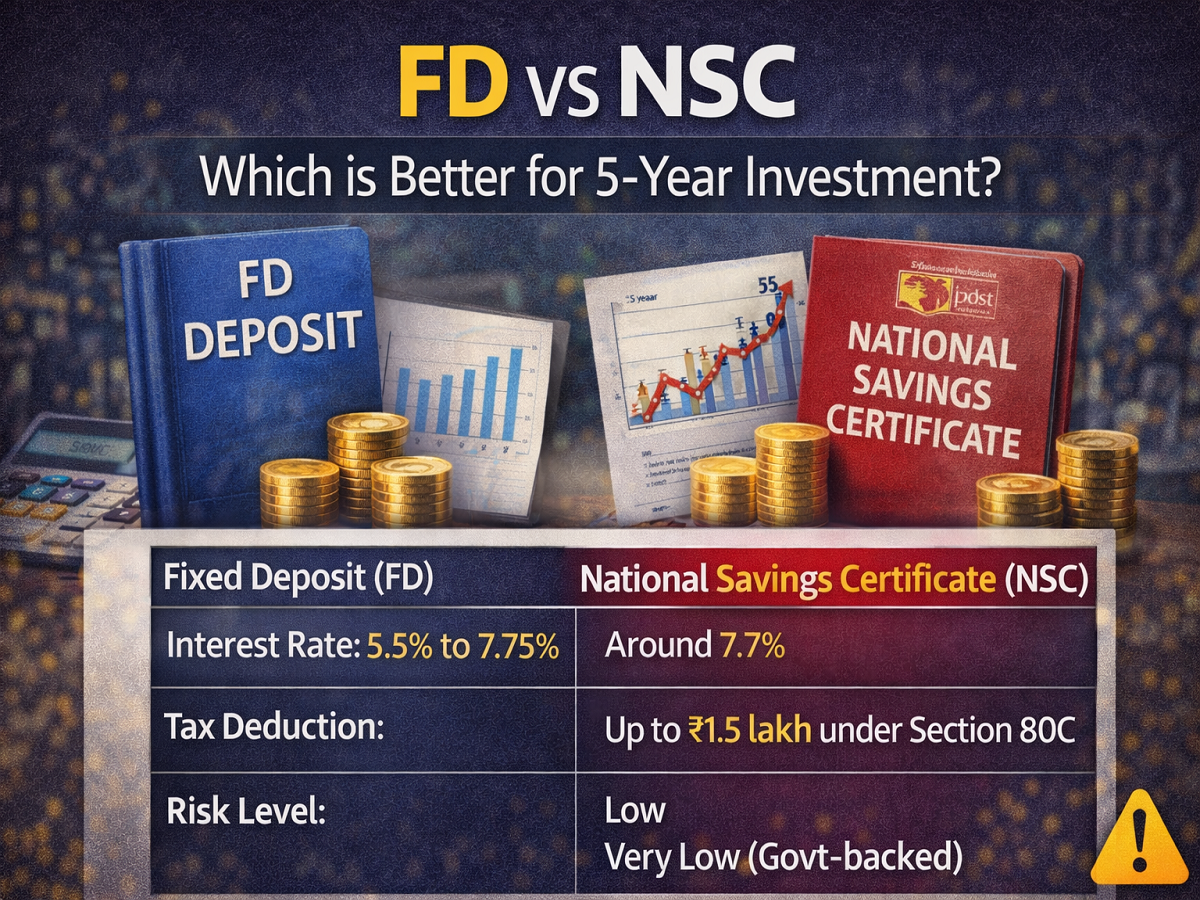
FD vs NSC: Which Is Better for a 5-Year Investment?
When planning an investment, most people focus on two key factors: safety and reliable returns. In India, two popular options that meet these expectations are Bank Fixed Deposits (FDs) and the National Savings Certificate (NSC).
Both investment instruments are considered relatively safe and also provide tax benefits under Section 80C of the Income Tax Act. However, they differ in terms of interest rates, taxation rules, and accessibility.
If you are considering a 5-year investment plan, understanding how these options work can help you make a more informed decision.
Bank Fixed Deposits: A Popular and Flexible Option
Bank Fixed Deposits (FDs) are one of the most widely used investment instruments in India. Almost every bank offers FD schemes with different tenure options and interest rates.
For a 5-year fixed deposit, most banks currently offer interest rates ranging between 5.5% and 7.75%, depending on the bank and market conditions.
Key Benefits of Bank FDs
-
Safe investment option backed by banks
-
Flexible tenure options
-
Easy to open and manage through banks
-
Tax deduction under Section 80C for tax-saving FDs
If you invest in a tax-saving FD, you can claim deductions of up to ₹1.5 lakh per year under Section 80C. This overall limit also includes other tax-saving investments such as PPF, EPF, and NPS.
Tax Rules on Fixed Deposit Interest
While FDs offer stable returns, it is important to understand the taxation rules.
The interest earned on fixed deposits is fully taxable and is added to your total income.
Banks may also deduct TDS (Tax Deducted at Source) if the interest income crosses the specified limit.
However, if your total income falls below the taxable limit, you can submit:
-
Form 15G (for individuals below 60 years)
-
Form 15H (for senior citizens)
Submitting these forms allows eligible investors to avoid TDS deductions.
National Savings Certificate: A Government-Backed Investment
The National Savings Certificate (NSC) is a small savings scheme offered by the Government of India through post offices.
It is considered a secure investment because it is government-backed and provides fixed returns.
Currently, NSC offers an interest rate of around 7.7% per year, with a fixed maturity period of 5 years.
Key Features of NSC
-
Government-backed investment
-
Fixed interest rate
-
5-year maturity period
-
Eligible for tax deduction under Section 80C
One of the major advantages of NSC is that investors can start with a minimum investment of ₹1,000, and there is no upper limit on investment.
Like tax-saving FDs, investments in NSC up to ₹1.5 lakh annually are eligible for tax deductions under Section 80C.
FD vs NSC: Key Comparison
| Feature | Bank Fixed Deposit (FD) | National Savings Certificate (NSC) |
|---|---|---|
| Risk Level | Low | Very low (government-backed) |
| Interest Rate | 5.5% – 7.75% depending on bank | Around 7.7% |
| Tenure | Flexible, including 5 years | Fixed 5-year maturity |
| Tax Benefit | Up to ₹1.5 lakh under Section 80C | Up to ₹1.5 lakh under Section 80C |
| Interest Taxation | Fully taxable | Interest reinvested and taxable |
| Availability | Banks | Post offices |
Which Option Should You Choose?
Both Bank Fixed Deposits and National Savings Certificates are considered safe investment options, especially for conservative investors who prefer stable returns.
Choose Bank FD If:
-
You prefer investing through banks
-
You want flexibility in choosing banks and tenure
-
You want easier online management of your investment
Choose NSC If:
-
You want a government-backed investment
-
You prefer stable, predictable returns
-
You are comfortable investing through post offices
Final Takeaway
Both FDs and NSC can be suitable options for a 5-year investment plan. While FDs offer flexibility and easy accessibility through banks, NSC provides the security of a government-backed scheme.
The right choice ultimately depends on your financial goals, tax planning strategy, and comfort with the investment platform.
Disclaimer
The information provided in this article is for educational and informational purposes only. It should not be considered as financial advice. Investors are advised to consult a certified financial advisor or investment expert before making any investment decisions.