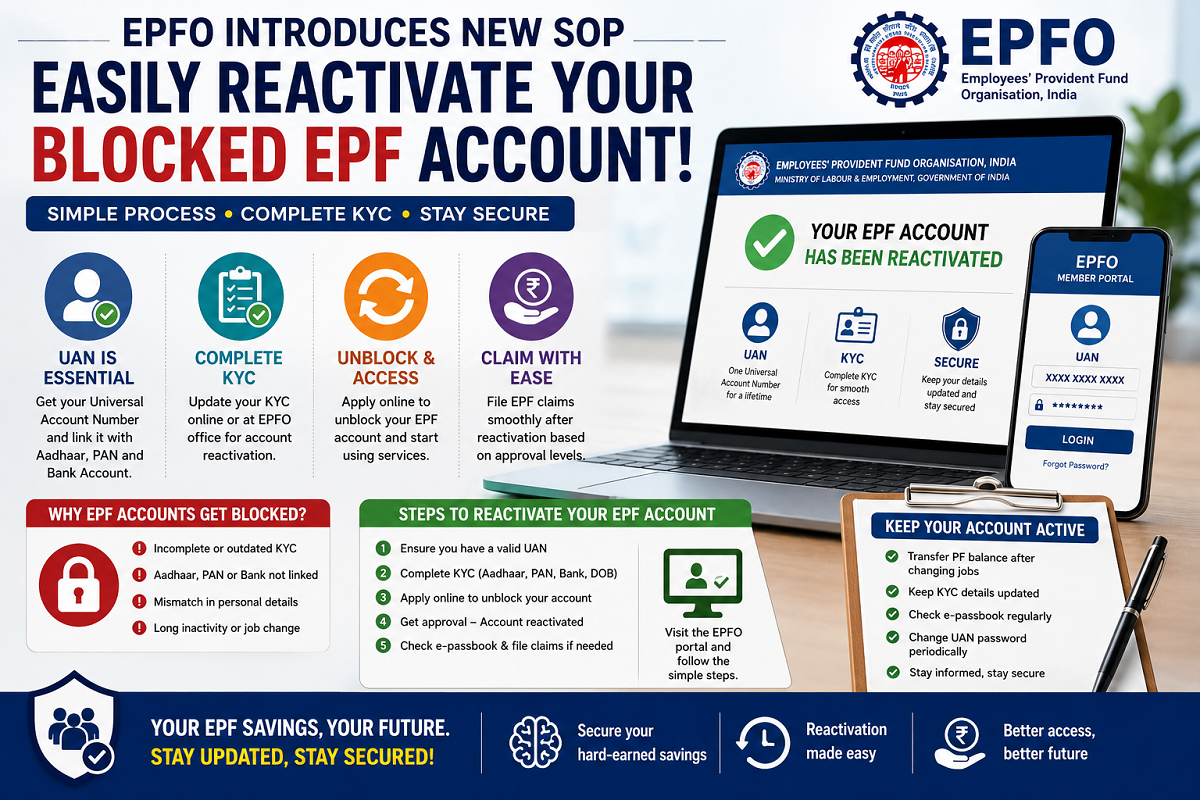
The Employees' Provident Fund Organisation (EPFO) has introduced a new Standard Operating Procedure (SOP) aimed at simplifying the process of reactivating blocked or inactive EPF accounts.
The updated procedure is expected to help employees whose Provident Fund accounts have become inactive, locked, or inaccessible due to incomplete documentation, KYC issues, or long periods of non-usage.
Under the new SOP, account holders can now follow a structured process to reactivate their EPF accounts and regain access to services such as PF claims, withdrawals, and account management.
Why UAN Is Important for EPF Account Reactivation
According to EPFO guidelines, having a valid Universal Account Number (UAN) is the first and most important requirement for reactivating a blocked EPF account.
The UAN acts as a unique identification number that links multiple PF accounts belonging to an employee throughout their career.
If a user does not already have a UAN, they may need to:
- Visit the nearest EPFO office
- Submit a request through the EPFIGMS portal
- Complete identity verification formalities
During the UAN activation process, employees may also need to provide:
- Bank account details
- Aadhaar information
- Biometric verification
Once the UAN and KYC verification process is completed successfully, the blocked EPF account may become eligible for reactivation.
KYC Completion Is Mandatory
EPFO has clarified that completing KYC (Know Your Customer) formalities is essential for unlocking or reactivating an EPF account.
Users who have not updated their KYC details are being advised to complete the process as soon as possible.
KYC updates can generally be completed:
- Online through the EPFO portal
or - By visiting an EPFO office physically
Important details that should remain updated include:
- Aadhaar number
- PAN card
- Bank account details
- Mobile number
EPFO has also emphasized that the name and date of birth in Aadhaar records and PF records must match correctly. Any mismatch may create verification problems or lead to account restrictions.
How to Update KYC Online
Users can update their KYC information through the official EPFO portal by following these steps:
- Log in to the EPFO member portal
- Go to the “Manage” section
- Select the “KYC” option
- Add or update required details
- Submit the information for verification
Once approved, the updated KYC details become linked with the user’s UAN profile.
EPF Claim Approval Process Explained
After account reactivation, employees can proceed with filing EPF claims if needed.
EPFO says claim processing may involve different approval levels depending on the claim amount.
According to the rules:
- Claims up to ₹5 lakh generally require first-level approval
- Claims above ₹5 lakh may require third-level approval
Because of this, maintaining accurate documents and updated KYC records becomes extremely important for smooth claim settlement.
Employees facing difficulties during claim filing may also seek assistance from field officers at EPFO offices.
Why EPF Accounts Usually Get Blocked
One of the most common reasons behind blocked EPF accounts is incomplete or outdated KYC information.
EPFO has clearly stated that users must ensure the following details are properly linked with their UAN:
- Aadhaar
- PAN
- Bank account
If any of these records remain unverified or outdated, the account may become inactive again even after reactivation.
Technical mismatches in personal information are also a major cause of account access problems.
What to Do If Online Reactivation Fails
In some cases, the online process may not work because of:
- Data mismatch
- Technical issues
- Verification errors
- Employer-related discrepancies
If this happens, employees may need to visit their nearest EPFO field office.
Users may then be asked to submit a Joint Declaration Form, which must usually be verified by:
- Current employer
or - Previous employer
Additional documents such as Aadhaar and PAN copies may also be required.
After verification by the Regional Provident Fund Commissioner (RPFC), the account can reportedly be reactivated manually.
How to Keep Your PF Account Active
EPFO has also advised employees to take certain steps to avoid future account blockage.
Some important recommendations include:
- Transfer old PF balance after changing jobs
- Regularly check e-passbook updates
- Keep KYC information updated
- Change UAN passwords periodically
- Monitor account activity regularly
Transferring PF balances after switching jobs helps maintain continuous service records and reduces the chances of account inactivity.
New SOP Expected to Help Millions of Employees
With increasing digitization of provident fund services, EPFO’s new SOP is being seen as an important step toward improving user convenience and reducing account-related complications.
The simplified reactivation process could benefit millions of employees who face difficulties accessing their PF savings due to inactive accounts or incomplete documentation.
Experts believe the move may also improve transparency and encourage more users to maintain updated EPF records digitally.