BUSINESS
8th Pay Commission: Five Key Employee Demands Take Center Stage Ahead of Crucial July Consultations
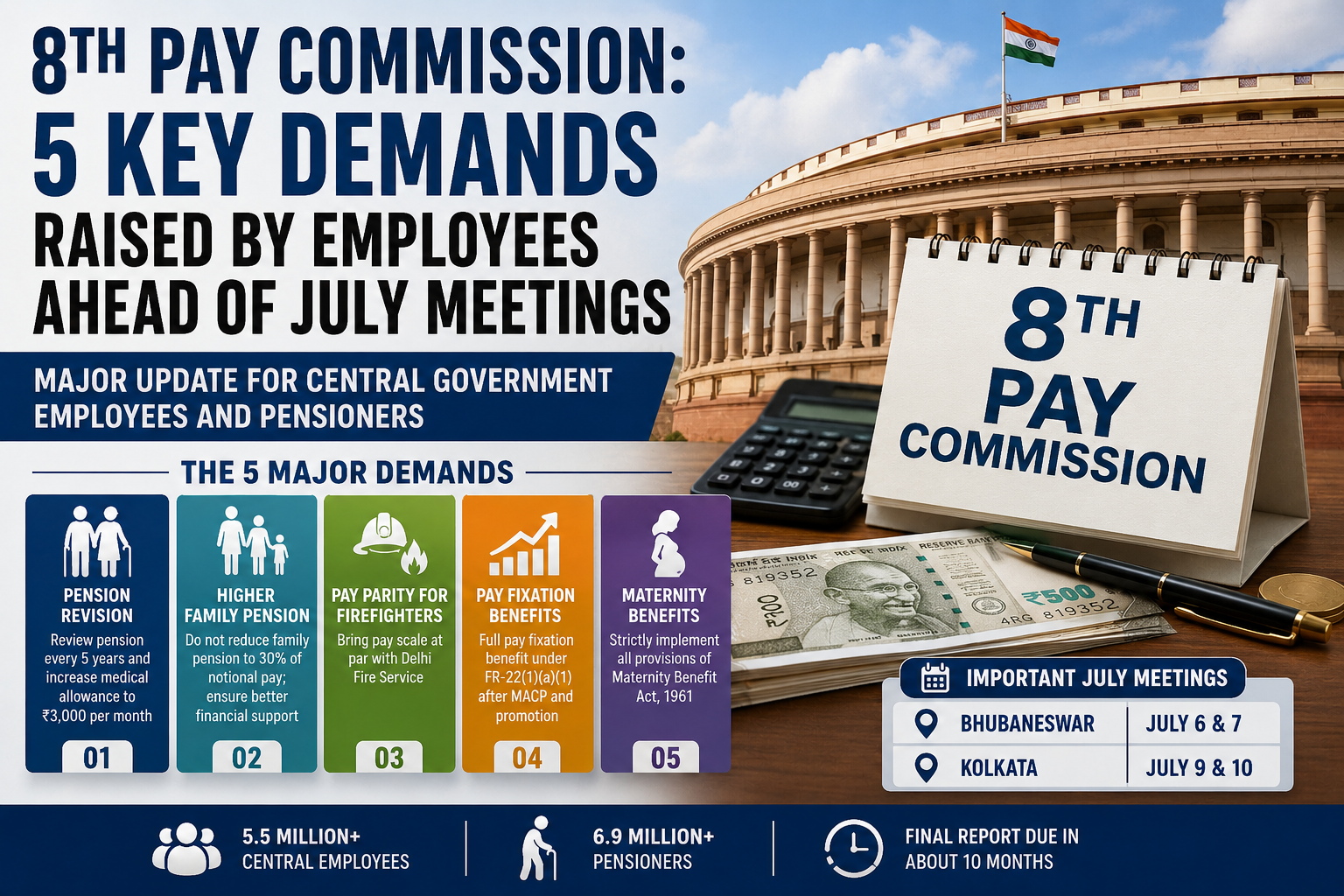
The upcoming meetings of the 8th Pay Commission are expected to play a significant role in shaping the future of salaries, pensions and service conditions for millions of central government employees and pensioners. As discussions move into the next phase, employee representatives have submitted five major demands that go far beyond salary hikes, focusing instead on long-standing issues related to pension benefits, pay parity, career progression and employee welfare.
The National Council of Joint Consultative Machinery (NC-JCM), which represents central government employees, has urged the commission to address these concerns during its scheduled consultations in July. The recommendations have reportedly been forwarded through the Cabinet Secretary, indicating that the issues are likely to receive serious consideration during the upcoming discussions.
July Meetings Could Be a Turning Point
The 8th Pay Commission, constituted on November 3, 2025, is entering an important phase of its work. With nearly eight months already completed since its formation, the commission has around ten months remaining to finalize and submit its recommendations to the central government.
During July, the commission will hold face-to-face consultations with employee unions and associations to gather their views before drafting its final proposals. These discussions are expected to influence future decisions regarding pay structures, pension policies and service-related reforms for nearly 5.5 million central government employees and approximately 6.9 million pensioners.
Five Major Demands Raised by Employee Representatives
Instead of focusing only on salary revision, employee organizations have highlighted several policy issues that they believe require immediate correction.
1. Pension Revision Every Five Years
One of the key demands is the introduction of a system that reviews pensions every five years. Employee representatives believe that periodic pension revisions would help retirees cope with rising living costs and inflation.
In addition, they have requested that the Fixed Medical Allowance for pensioners be increased to ₹3,000 per month to better meet healthcare expenses.
2. Higher Family Pension Benefits
Another important issue relates to family pension.
Currently, after the death of a government employee or pensioner, the family pension is calculated at a reduced level. Employee representatives have requested that the pension should not be reduced to 30% of the deceased employee's notional pay. Instead, they want the government to provide higher financial support to surviving family members.
3. Equal Pay for Central Government Firefighters
The NC-JCM has also demanded pay parity for firefighters employed in various central government departments.
According to employee representatives, firefighters performing similar duties should receive the same pay scale as personnel serving in the Delhi Fire Service, ensuring equal compensation for comparable responsibilities.
4. Full Pay Fixation Benefits After Promotion
The employee side has requested that government staff who receive promotions after being granted financial upgradation under the Modified Assured Career Progression (MACP) Scheme should receive full pay fixation benefits under FR-22(1)(a)(1).
They argue that the existing system creates disparities and prevents eligible employees from receiving the financial advantage normally associated with promotions.
5. Strict Implementation of Maternity Benefits
Another major demand focuses on improving welfare measures for women employees.
The employee organizations have urged the government to fully implement all provisions of the Maternity Benefit Act, 1961, across central government departments to ensure uniform maternity benefits and stronger workplace protections for female employees.
Additional Issues Also Raised
Besides these five primary demands, employee unions have once again requested the government to review several long-pending pension-related matters.
These include:
-
Revision of pensions for existing retirees.
-
Earlier restoration of commuted pension benefits.
-
Reconsideration of the demand to restore the Old Pension Scheme (OPS).
Although these issues remain under discussion, no final decision has been announced by the government or the commission.
Important July Meeting Schedule
According to information published on the official website of the 8th Pay Commission, consultations with employee unions and associations will take place in two cities during July.
Meeting Schedule:
-
Bhubaneswar: July 6 and July 7
-
Kolkata: July 9 and July 10
Representatives from various employee organizations are expected to present their suggestions directly before the commission. If multiple unions express similar concerns, a broader consensus may emerge on several service-related reforms.
No Decision Yet on Salary Hike or Fitment Factor
Despite growing expectations among employees, the commission has not yet announced any recommendation regarding salary revision or the fitment factor.
Discussions on these financial aspects are expected to continue after consultations with employee organizations and other stakeholders are completed.
As a result, speculation surrounding revised pay scales remains premature until the commission formally submits its recommendations.
Final Report Still Several Months Away
The July consultation round is likely to be one of the most significant stages in the commission's work. With approximately ten months remaining before the final report is due, these meetings will help determine the direction of future recommendations on salaries, pensions, allowances and service conditions.
For millions of central government employees and pensioners, the upcoming discussions are expected to provide valuable insight into how the 8th Pay Commission may reshape compensation policies in the years ahead. However, all proposed changes will only take effect after the commission submits its final report and the central government approves its recommendations.