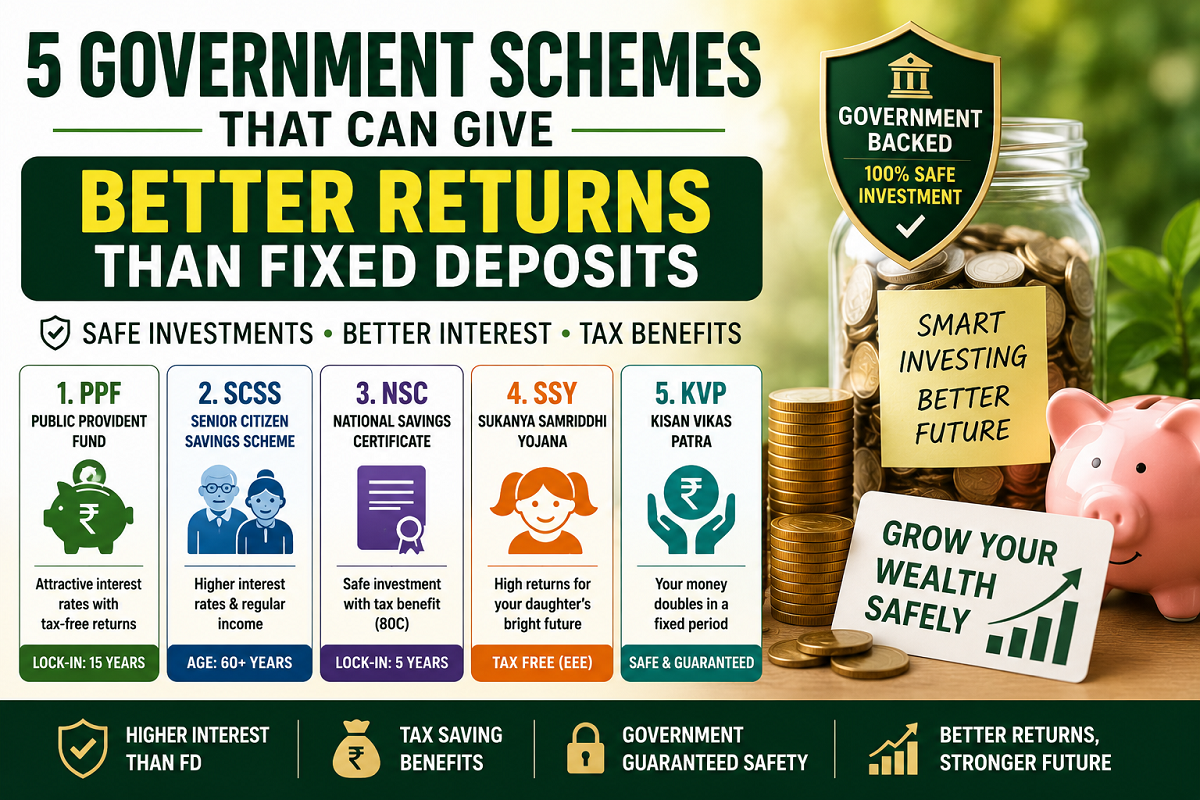
When it comes to safe investments in India, Fixed Deposits (FDs) continue to remain one of the most trusted choices among investors. The biggest reason behind their popularity is guaranteed returns along with minimal market risk. However, in recent years, several government-backed savings schemes have emerged as strong alternatives to traditional FDs by offering higher interest rates, tax-saving benefits, and better long-term wealth creation opportunities.
For investors looking to build a secure financial future without taking excessive risks, these schemes can prove highly beneficial. Many of them are backed by the Government of India, making them reliable investment options for conservative and long-term investors alike.
Here are five government savings schemes that could potentially generate better returns than traditional fixed deposits in 2026.
Public Provident Fund (PPF)
The Public Provident Fund, popularly known as PPF, has long been considered one of India’s safest and most reliable long-term investment schemes. Since it is backed by the Government of India, the invested money remains highly secure.
One of the biggest advantages of PPF is that it offers attractive interest rates compared to many bank fixed deposits while also providing tax-free returns. Investments made under this scheme qualify for tax deductions under Section 80C of the Income Tax Act.
Another major highlight is its Exempt-Exempt-Exempt (EEE) tax status, which means:
Investment amount gets tax benefit
Interest earned remains tax-free
Maturity amount is also tax-free
The scheme comes with a maturity period of 15 years, making it suitable for investors focused on long-term financial goals such as retirement planning or wealth creation.
Senior Citizen Savings Scheme (SCSS)
The Senior Citizen Savings Scheme is specially designed for retired and elderly investors who want stable and regular income after retirement.
SCSS is widely regarded as one of the highest-return government-backed investment schemes in India. Compared to most bank FDs, it generally offers a better interest rate along with sovereign security.
Key Benefits of SCSS
Government-backed safety
Higher returns than regular bank deposits
Regular income through interest payouts
Tax deduction benefits under Section 80C
Only individuals aged 60 years and above are eligible to invest in this scheme, although certain early retirees may also qualify under specific conditions.
Due to its stable returns and reliable income structure, SCSS remains extremely popular among senior citizens looking for financial security after retirement.
National Savings Certificate (NSC)
The National Savings Certificate, commonly known as NSC, is another popular small savings scheme suitable for conservative investors who seek both safety and tax savings.
Operated through post offices across India, NSC offers guaranteed returns at fixed interest rates determined by the government. The scheme also qualifies for tax benefits under Section 80C.
Why Investors Prefer NSC
Safe and low-risk investment
Guaranteed maturity amount
Tax-saving advantage
Easy accessibility through post offices
Since the investment remains protected from market fluctuations, NSC is especially preferred by small and middle-class investors looking for stable long-term savings options.
Sukanya Samriddhi Yojana (SSY)
For families with daughters, Sukanya Samriddhi Yojana can be one of the most rewarding long-term investment schemes available today.
Launched to support the financial future of girl children, this government scheme is specifically designed to help parents build funds for education and marriage expenses.
Major Advantages of SSY
Interest rates often higher than many FDs
Complete tax exemption on investment, interest, and maturity
Government-backed safety
Long-term wealth creation potential
Even with relatively small annual investments, parents can gradually build a substantial corpus over time. Because of its attractive returns and tax-free benefits, SSY has become one of the most preferred savings schemes for families across India.
Kisan Vikas Patra (KVP)
Kisan Vikas Patra is another trusted government-backed savings instrument known for stable and guaranteed returns.
One of the biggest attractions of KVP is that the invested money approximately doubles within a predefined period. The scheme is ideal for individuals who prefer secure investments without exposure to market risks.
Features of KVP
Guaranteed returns
Easy investment process
Available through post offices
Suitable for conservative investors
Government-backed protection
Investors looking for predictable long-term growth often consider KVP a safer alternative to traditional bank deposits.
FD vs Government Savings Schemes: Which Is Better?
Fixed Deposits still remain a dependable option for people who prioritize simplicity and guaranteed income. However, government-backed savings schemes now offer several additional advantages such as:
Higher interest rates
Tax-saving opportunities
Long-term wealth creation
Sovereign security
Tax-free maturity benefits in some schemes
For investors whose goals include not only capital protection but also tax efficiency and higher long-term returns, schemes like PPF, SCSS, NSC, SSY, and KVP may prove more beneficial than regular bank FDs.
Choosing the Right Investment Strategy
Every investment option serves a different purpose. The best choice depends on factors such as:
Age
Financial goals
Investment horizon
Liquidity needs
Tax planning requirements
Risk tolerance
For example:
PPF suits long-term wealth creation
SCSS is ideal for retirees
SSY helps secure a daughter’s future
NSC supports tax-saving goals
KVP works well for stable guaranteed growth
Before investing, experts advise evaluating your financial objectives carefully and consulting a qualified financial advisor whenever necessary.
Disclaimer: This article is intended for informational purposes only and should not be considered financial advice. Investors should consult certified financial professionals before making investment decisions.